

The Greek Interlude
The Ancient Greek civilization had a significant interlude between the heroic days of Agamemnon and the Golden Age of Athenian Democracy. Back in 1194 BCE (when the siege of Troy seems to have happened), the cities of Argos and Mycenae were significant centers of power. Yet, these two cities are barely mentioned in the days of Pericles. What happened? For a while, historians thought there had been a wave of immigration that came down upon Greece from the restlessly expanding north. Historians called it the Dorian invasion, in which a warlike people, tall, roundheaded, letterless, slipped or marched or poured into the Peloponnesus and almost completely destroyed Mycenaean civilization. It was also suspected that the Dorian victory was owed to the superiority of iron weapons—which the Hellenic culture had not developed yet. In the second half of the XX century this tale (which the Nazis had readily adopted and imagined they were the Dorians) seems to have been rejected as an archeological hypothesis. Nonetheless, the collapse of the Bronze period of Ancient Greece and the interlude in cultural heritage is real—but now considered multi-causal. It took four centuries for the Greeks to overcome this dark period, and what came after is the so-called Classical Greek civilization as we came to know it—beginning with the Ionian Awakening sparked by Thales and Anaximander (c. 600 BCE), peaking thanks to the rise of Democracy developed by Solon and Cleisthenes (c. 500 BCE), declining with the Peloponnesian war/suicide enabled by Pericles and Alcibiades (c. 400 BCE), and ending with the Roman conquest lamented by Pyrrhus and Archimedes (c. 300 BCE).
Source: Durant, Will, 1885-1981, The Story of Civilization, Vol. 2: The Life of Greece , A history of Greek government, industry, manners, morals, religion, philosophy, science, literature and art from the earliest times to the Roman conquest. Simon and Schuster, 1939.
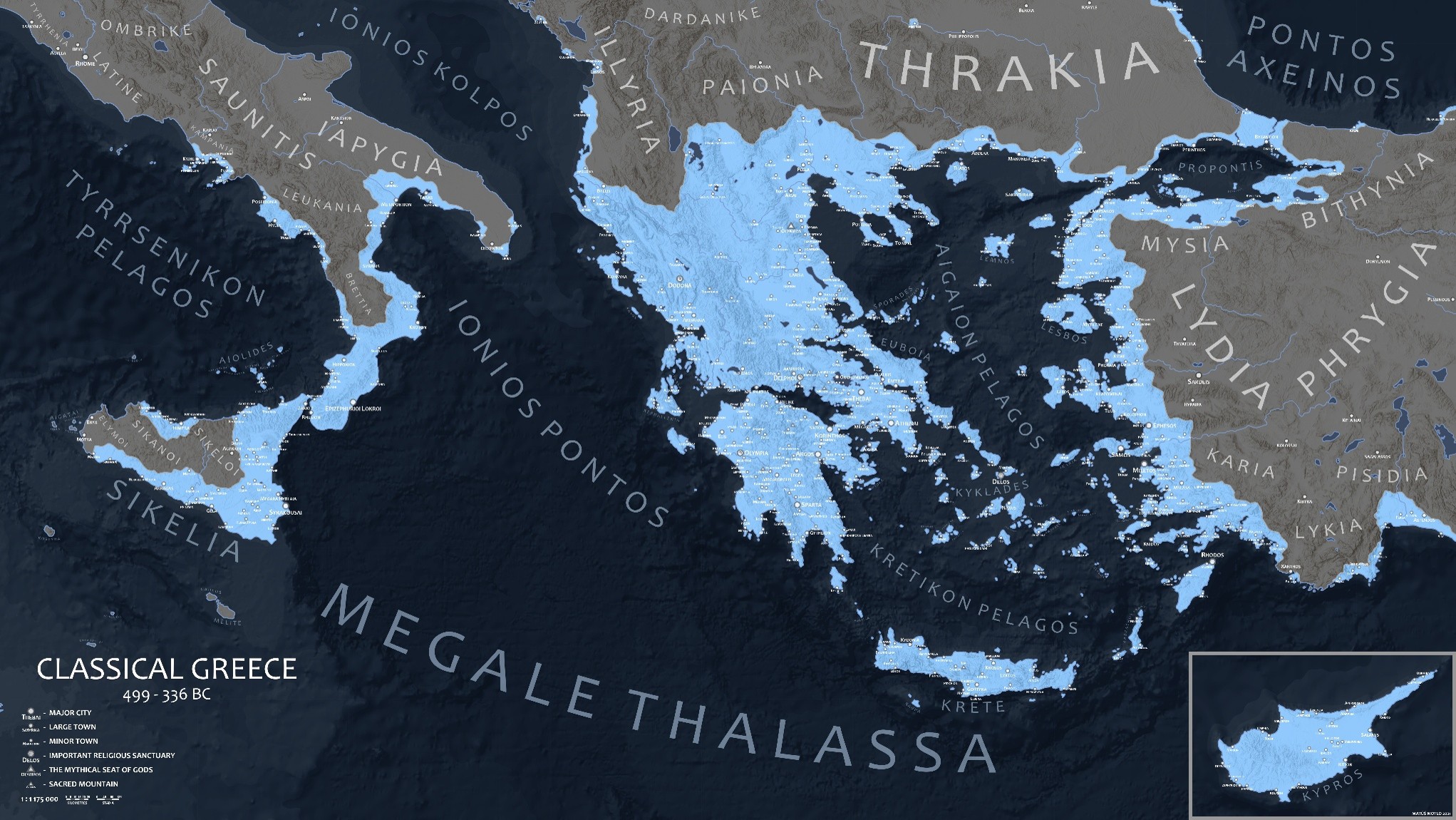
Image by WendishAstronomer under CC BY-NC-ND 3.0 license
Back to archive
Full disclosure, I may occasionally borrow a sentence from Will Durant's Story of Civilization. I absolutely love that collection!