

Ashurbanipal
In 626 BCE Ashurbanipal the last king of Assyria died. He was the last of an unbroken list of kings lasting 1450 years, and took Assyria to its climax over many bloody conquests. Fourteen years after his death, an army of Babylonians under Nabopolassar—united with an army of Medes under Cyaxares and a horde of Scythians from Caucasus—invaded Assyria, and with amazing ease and swiftness captured the citadels of the North. At one blow Assyria disappeared from history.
Before its fall, Assyria was the third civilization that developed in what is known today as the cradle of civilization. Babylonia and Sumeria came before it. In this succession, Sumeria was to Babylonia, and Babylonia to Assyria, what Crete was to Greece, and Greece to Rome: the first created a civilization, the second developed it to its height, the third inherited it, added little to it, protected it, and transmitted it as a dying gift to the encompassing and victorious barbarians. Some of the progress observed in Assyria include the oldest aqueduct ever found, one of the earliest examples of an official coinage, some of the first libraries (one of them containing 30,000 tablets), the first known mention of cotton, significant development of bas relief, and (although not uniquely here) the replacement of bronze by iron. The art of Government is not something they inherited from Babylonia—the code of Hammurabi was far superior to anything Assyria ever produced—and government was primarily an instrument of war for a war ridden kingdom with constant rebellions and suppressions (see an example from Ashurbanipal himself below). Nonetheless the government of Ashurbanipal—which ruled Assyria, Babylonia, Armenia, Media, Palestine, Syria, Phoenicia, Sumeria, Elam and Egypt—was without doubt the most extensive administrative organization yet seen in the Mediterranean or Near Eastern world; only Hammurabi and Thutmose III had approached it, and Persia alone would equal it before the coming of Alexander.
“all the chiefs who had revolted I flayed, with their skins I covered the pillar, some in the midst I walled up, others on stakes I impaled, still others I arranged around the pillar on stakes .... As for the chieftains and royal officers who had rebelled, I cut off their members”... “I burned three thousand captives with fire, I left not a single one among them alive to serve as a hostage” … “"These warriors who had sinned against Ashur and had plotted evil against me ... from their hostile mouths have I torn their tongues, and I have compassed their destruction. As for the others who remained alive, I offered them as a funerary sacrifice; their lacerated members have I given unto the dogs, the swine, the wolves. . . By accomplishing these deeds I have rejoiced the heart of the great gods."' Another monarch instructs his artisans to engrave upon the bricks these claims to the admiration of posterity: “My war chariots crush men and beasts. . . . The monuments which I erect are made of human corpses from which I have cut the head and limbs. I cut off the hands of all those whom I capture alive.”
Source: Durant, Will, The Story of Civilization, Vol. 1: Our Oriental Heritage, A history of civilization in Egypt and the Near East to the Death of Alexander, and in India, China, and Japan from the beginning. New York: Simon & Schuster, 1954.
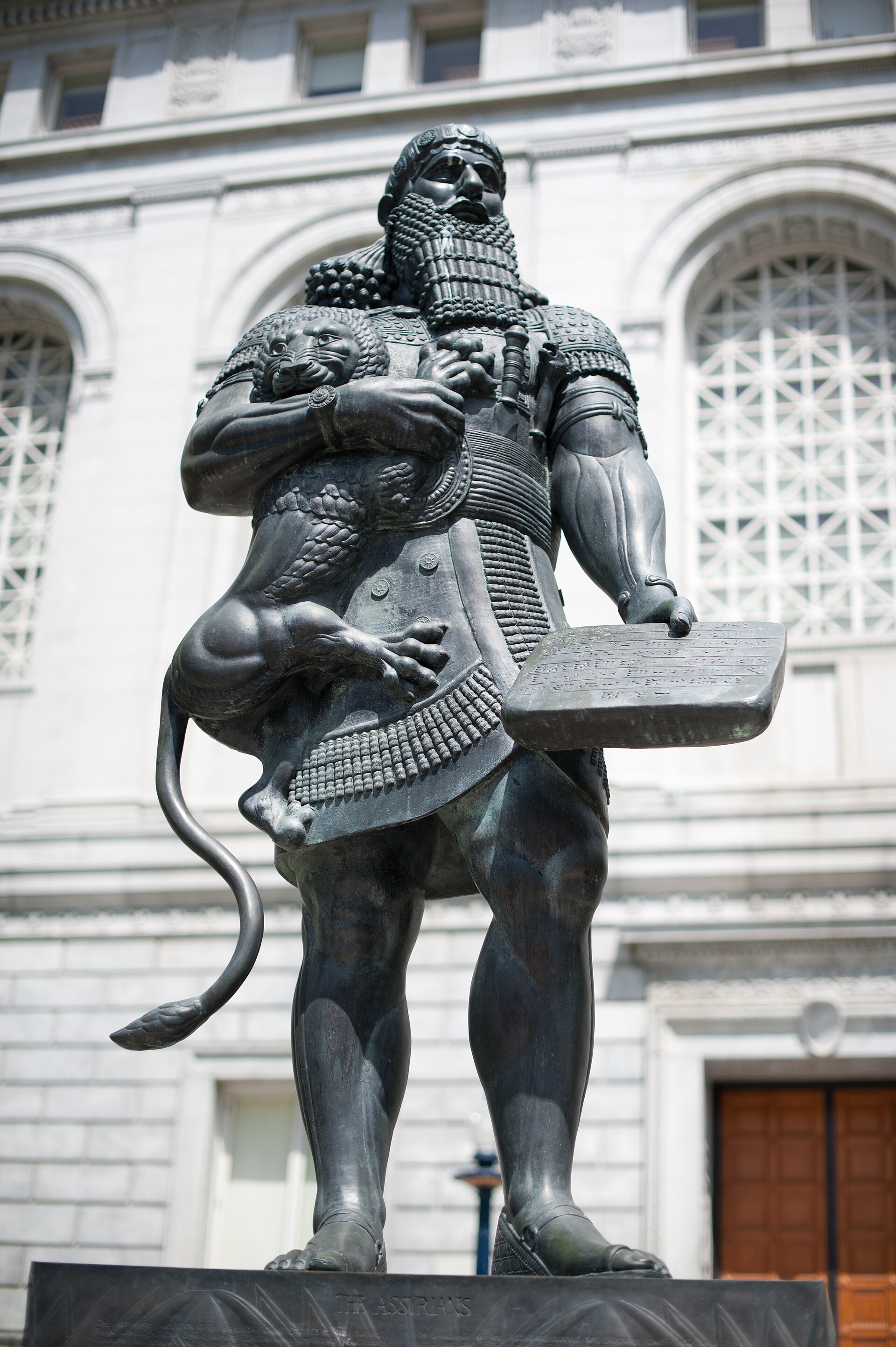
Image by Almonroth under CC BY-SA 3.0 license
Back to archive
Full disclosure, I may occasionally borrow a sentence from Will Durant's Story of Civilization. I absolutely love that collection!