

Thomas Aquinas
Thomas Aquinas (born in 1225) was to be a better asset to the Church than Abélard; but still, reason was never meant to be its shield. He studied at Monte Cassino, the University of Naples, and later under Albertus Magnus; infecting himself at every step with Greek, Arabic, and Hebrew influences. A lover of knowledge, he once said that “of all human pursuits the pursuit of wisdom is the most perfect, the most sublime, the most profitable, the most delightful.” And indeed he delighted in this pursuit. His writings span the universe, but contain not one immodest word or a heretic passage. In logic, he manages to go further than Abélard in his reconciliation of the Trinity. In metaphysics, he claims that essence and existence are different in things—something that Descartes would later struggle to explain. In theology, he places God on an unattainable pedestal, knowable only by analogy whilst being existence in its purest form. In Psychology, he agrees with Aristotle and Locke that “there is nothing in the intellect that was not first in the senses”; but he adds, like Leibniz and Kant, "except the intellect itself". In Ethics, he proposes an excellent scapegoat, claiming that sin is the price we must pay for our freedom of choice. And in Politics, he agrees with Aristotle in that monarchy is the best government, that communism is unnatural, and that some people are meant to be slaves. But try as he might, he did not succeed in fully reconciling Aristotle and Christianity; instead, in the struggle, he won an epochal victory for reason. After his death, Thomas’ writings were seen as a monstrous accumulation of pagan reasoning, fatal to the Christian faith, but this changed. Today Christianity still celebrates his brave attempt; in 1879 Pope Leo XIII, and in 1921 Pope Benedict XV, while not pronouncing his works free from all error, made them the official philosophy of the Catholic Church; and in all Roman Catholic colleges that philosophy is taught today.
Source: Durant, Will. The Story of Civilization, Vol. 4: The Age of Faith, A History of Medieval Civilization, Christian, Islamic, and Judaic, From Constantine to Dante, A.D. 325-1300. New York: Simon and Schuster, 1950.
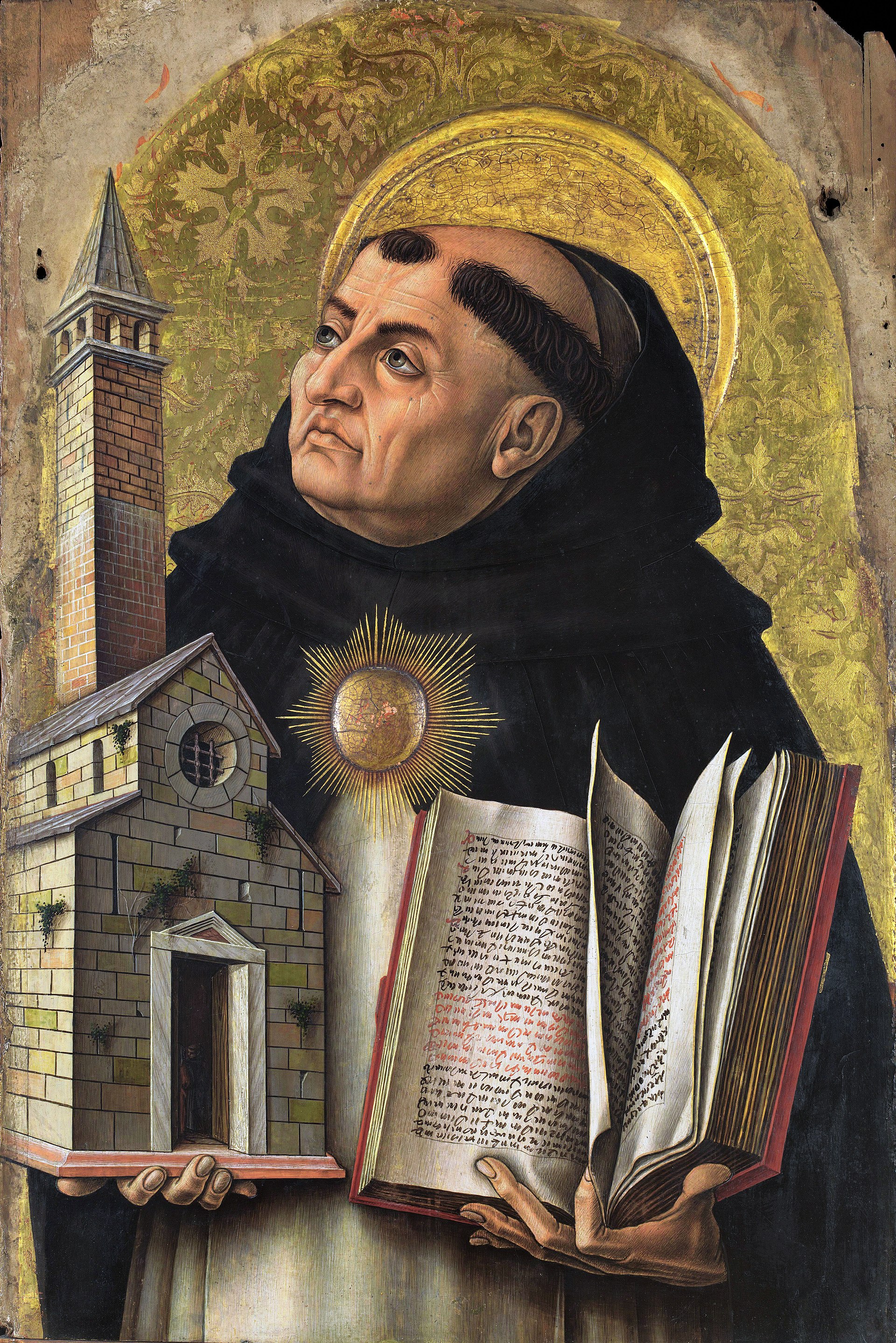
Public Domain
Back to archive
Full disclosure, I may occasionally borrow a sentence from Will Durant's Story of Civilization. I absolutely love that collection!