

Frederick II
On December 26th 1194, Frederick II, grandson of Frederick Barbarossa, was born. His grandfather is famous for participating in the second, and third crusades—while he had his hand on the sixth—but the younger Frederick did so much more! He came into the world in Jesi (near Ancona), Italy. It was an inconspicuous place for someone carrying the blood of the Norman Kings of Italy and of the Hohenstaufen Emperors (through his mother and father respectively), but despite having a difficult ascension ahead of him, he was destined to be the most fascinating figure of the culminating medieval century.After his father died (a year before Frederick was born) the power of the German crown passed to a house from British descent, and Frederick would have to content himself with the crown of Sicily. He was crowned at age four. Much like Alexander (whose father predicted "Macedonia is too small for thee"), Sicily was too small for Frederick. His fate manifested when feuds between the German crown, the Church, and other rising kingdoms, enabled Frederick II to take his rightful German throne at age 21. But he would not stop there. Through his ties to the Church and the German hegemony, he became Holy Roman Emperor at age 26. Through marriage, he obtained the title of King of Jerusalem at age 31. And through bloody struggles with the Church, he effectively ruled over Italy and the Papal states. The last person with such an extensive resume was Charlamagne, 400 years earlier (link). As he grew older (much like Charlamagne), Frederick turned more and more to science and philosophy. His curiosity was universal. He sent questions in science and philosophy to scholars at his court, and as far abroad as Egypt, Arabia, Syria, and Iraq. He kept a zoological garden for study rather than for amusement, and organized experiments in the breeding of poultry, pigeons, horses, camels, and dogs (see quoted text below). Nonetheless, the characteristic brittleness of every conqueror's ascension caught up to him. Around 1249, evidence was brought to him that his trusted premier was conspiring to betray him; In that same year news came that his son had been captured by the Bolognese in battle at La Fossalta; and about the same time Frederick's doctor tried to poison him. The quick succession of these blows broke the spirit of the Emperor. He retired to Apulia, and took no further part in the wars against the Papacy. In 1250, dysentery, the humbling nemesis of medieval kings, struck the proud Emperor down. By this time, he had become the 'enemy #1' of the Church, so he asked for absolution, received it, donned the garb of a Cistercian monk, and died at Fiorentino on December 13th. People whispered that his soul had been borne off by devils through the pit of Mt. Etna into hell. Soon, his empire collapsed, and a greater chaos ruled it than when he came—the unity for which he fought disappeared…Perhaps the world was not ready for this "man of the Renaissance" who came a century before its time. But his legacy remains: Matthew Paris called him "stupor mundi et immutator mirabilis" (the marvelous transformer and wonder of the world), and Nietzsche had Bismarck and Napoleon in mind, but he acknowledged the influence of Frederick—"the first of Europeans according to my taste."
Excerpt from Durant’s Age of Faith:
"The most scientific work of medieval biology was Frederic II's De arte venandi cum avibus, a 589-page treatise on "the art of hunting with birds." It was based partly on Greek and Moslem manuscripts, but largely on direct observation and experiment; Frederick himself was an expert falconer. His description of bird anatomy contains a great number of original contributions; his analysis of the flight and migration of birds, his experiments on the artificial incubation of eggs and the operations of vultures show a scientific spirit unique in his age. Frederick illustrated his text with hundreds of drawings of birds, perhaps from his own hand-drawings "true to life down to the tiniest details." The menagerie that he collected was not, as most contemporaries thought, a whim of bizarre display, but a laboratory for the direct study of animal behavior. This Alexander was his own Aristotle."
Source: Durant, Will, 1885-1981, The Age of Faith: A History of Medieval Civilization, Christian, Islamic, and Judaic, From Constantine to Dante, A.D. 325-1300. Simon and Schuster, 1950.
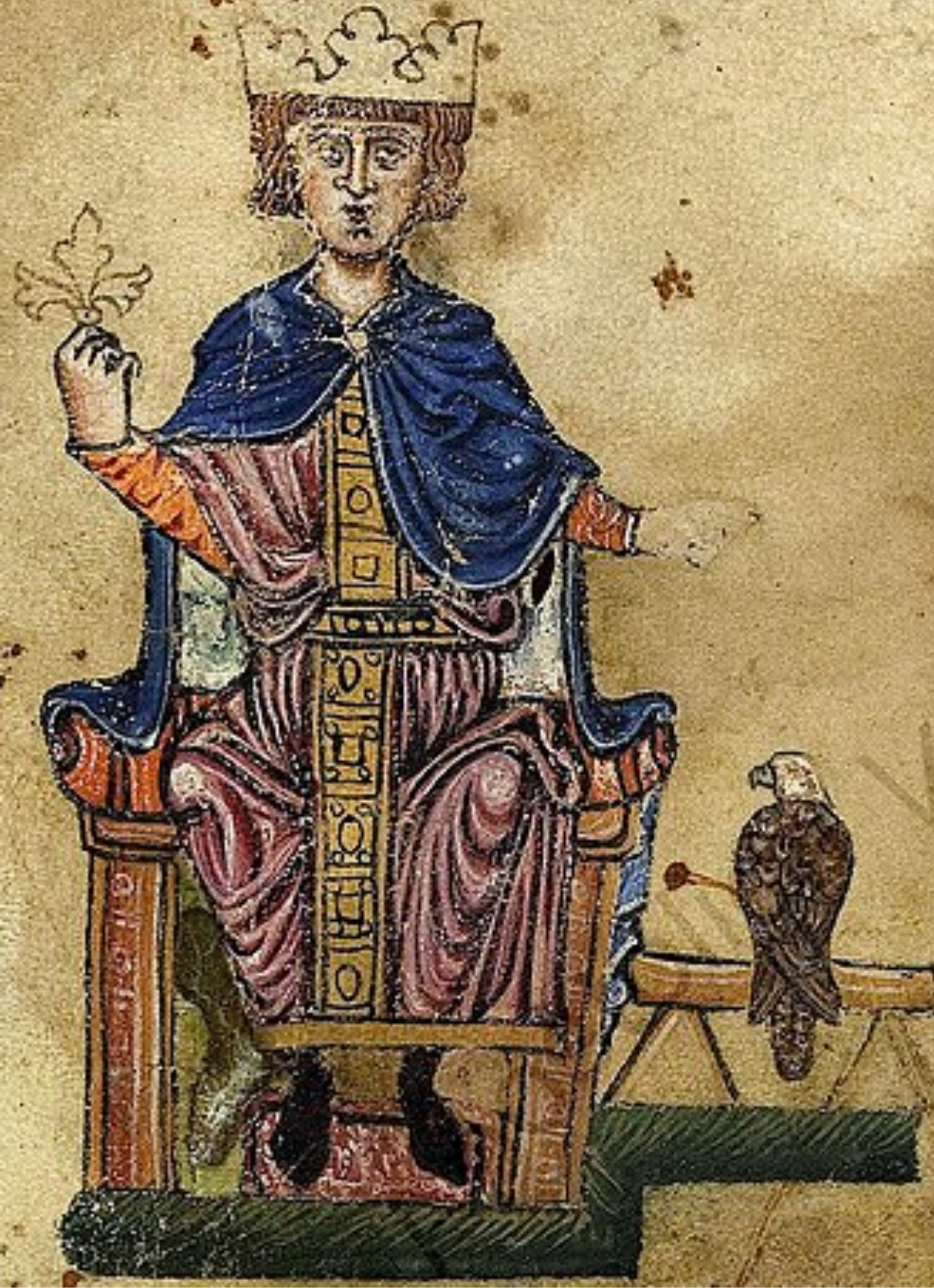
Public Domain
Back to archive
Full disclosure, I may occasionally borrow a sentence from Will Durant's Story of Civilization. I absolutely love that collection!