

Roger Bacon
Roger Bacon was more than a scholastic philosopher; he was the most famous of medieval scientists. Like Aristotle, he brought the somewhat obscure ideas of his predecessors and turned them into scientific works; but unlike Aristotle, Roger had the luck of inheriting centuries of knowledge at Oxford from men like Alexander Neckham, Bartholomew, Robert Grosseteste, and Adam Marsh. So he dusted off the concepts and proclaimed them to the world. His Scriptum Principale (Principal Work), was a one-man encyclopedia to be in four volumes. Realizing that it was far too lengthy to be of interest to his contemporaries, he summarized it into his “Larger Work” (c. 1267). In it, with surprisingly prophetic passages, Roger alludes to modern machines (like airplanes and mechanical boats), x-rays and other "penetrating rays", the microscope and telescope (brilliantly pointing out their revolutionary power). He also describes gunpowder surprisingly well; he does not claim to have invented gunpowder; he was merely one of the first to study its chemistry and foresee its possibilities. Then, eager to have the pope recognize this work, but still worried about the pope’s attention span, he condensed it further into a "Minor Work" and an "Opus Tertium". The pope died and Roger never got any recognition from the Church. Perhaps the failure of the popes to respond in any way to Bacon's program and appeals darkened his spirit and embittered his pen. In the ‘Compendium Philosophiae’ almost every phase of thirteenth-century life felt his lash: the disorder of the papal court, the degeneration of the monastic orders, the ignorance of the clergy, the dullness of sermons, the misconduct of students, the sins of the universities, the windy verbiage of the philosophers. As a result, he was one of the victims of the condemnations of 1277, but we don't know how severe the conditions were, nor how long it lasted. We are told that in 1292 certain prisoners were freed. Presumably Bacon was released then or before, for in 1292 he published a ‘Compendium studio theologiae’. Thereafter we have only an entry in an old chronicle: “The noble doctor Roger Bacon was buried at the Grey Friars” (the Franciscan church) “in Oxford in the year 1292.”
Source: Durant, Will. The Story of Civilization, Vol. 4: The Age of Faith, A History of Medieval Civilization, Christian, Islamic, and Judaic, From Constantine to Dante, A.D. 325-1300. New York: Simon and Schuster, 1950.
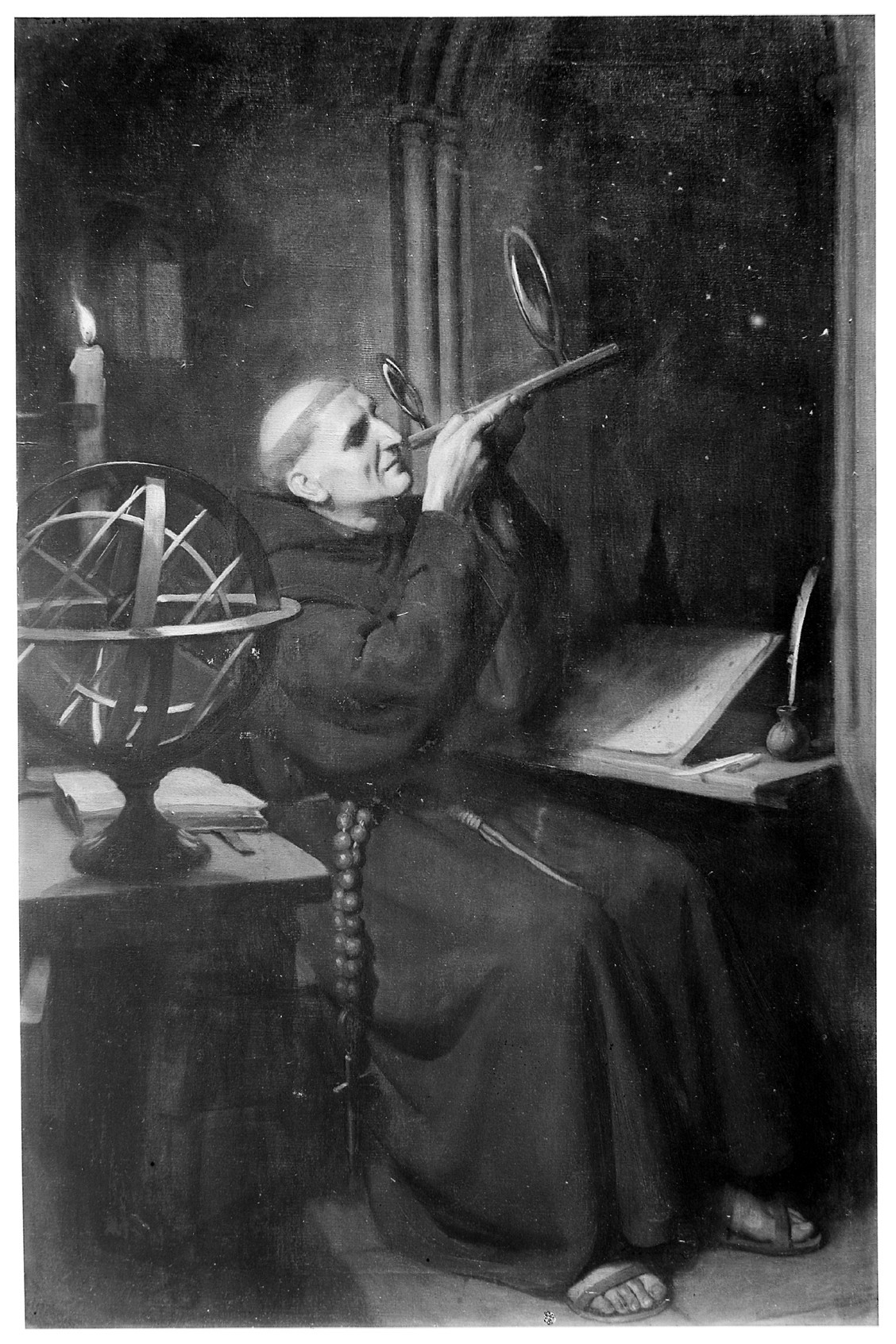
Image from the Wellcome Collection under CC BY 4.0 license
Back to archive
Full disclosure, I may occasionally borrow a sentence from Will Durant's Story of Civilization. I absolutely love that collection!