

Aristotle
Aristotle, born in 384 BCE, had the fortunate (and unfortunate) position of being Pato’s pupil. Perhaps Aristotle would have been as great as Democritus had it not been for the nonsense he had to put up with from his teacher. Plato and Aristotle stood at the zenith of philosophy, battling for the mystical and the medical respectively. Nevertheless, when Plato died, Aristotle built an altar to him; for he had loved Plato, even if he could not like him. Like his teacher, he also had to flee Athens for a time after the dictatorship of his father-in-law was deposed. He lived in Lesbos temporarily but was later summoned by Alexander's father (343) to teach the young warrior (a lad of thirteen at the time). Aristotle came to Pella and labored at the task for four years. In 334 he returned to Athens and opened a school of rhetoric and philosophy—probably aided by funds from Alexander. He called it the Lyceum, and collected here a large library, a zoological garden, and a museum of natural history. Through this school, he set up pockets of knowledge that he later shaped into twenty-seven popular dialogues for which he was known in the ancient world. None of these survived. What remains to us is a mass of technical, highly abstract, and inimitably dull works rarely referred to by ancient scholars. These technical compendiums were apparently composed, in the last twelve years of his life, of notes made for his lectures by himself, or from his lectures by his pupils. Forty survived, but Diogenes Laertius mentions 360 more.
Unlike Plato, Aristotle criticized the idea of figuring out the universe by thought (preferring observations)—and although he had the discipline of Tycho, he lacked the vision of Kepler; classifying a myriad of things without drawing conclusions. Nonetheless, he dared to enter every field: stated the law of the lever, mentioned the sphericity of the Earth, dabbled in geology, explained many meteorological phenomena without the use of deities, and much more. In Biology he is most at home; this discipline had to wait twenty centuries for his equal. Nonetheless, it is where he made the most mistakes. His treatises are a sea of reason and observation peppered with errors so gross that oftentimes could be mistaken for pranks by his students trying to sabotage their teacher’s notes. A master of observation and lover of taxonomy, he points out that the sponge is difficult to classify as a plant or an animal. He also describes an experiment for observing the development of the chicken embryo and deduces that man must develop in the same way. On the metaphysical side, he defines the soul and classifies its strata across plants, animals, men, and God. He talks so passionately about God—a Prime Mover Unmoved, First Cause Uncaused, the Creator of All—that Christian and Islamic philosophers relied on him heavily to conquer the minds of millions. On the milder side, he says “the good life is the happy life” and that “no man can be happy who is absolutely ugly”. Virtue is not an act but a habit. Like his teacher, he labored endlessly to develop theoretical methods of government, and suggested a “timocracy”—a combination of aristocracy and democracy in which the suffrage will be restricted to landowners, and a strong middle class will be the balance wheel and pivot of power. All-in-all, so far as we know, never had anyone amassed such an impressive edifice of thought. He truly had become “the master of those who know” and the father of the scientific method.
Source: Durant, Will, 1885-1981, The Life of Greece: A history of Greek government, industry, manners, morals, religion, philosophy, science, literature and art from the earliest times to the Roman conquest. Simon and Schuster, 1939.
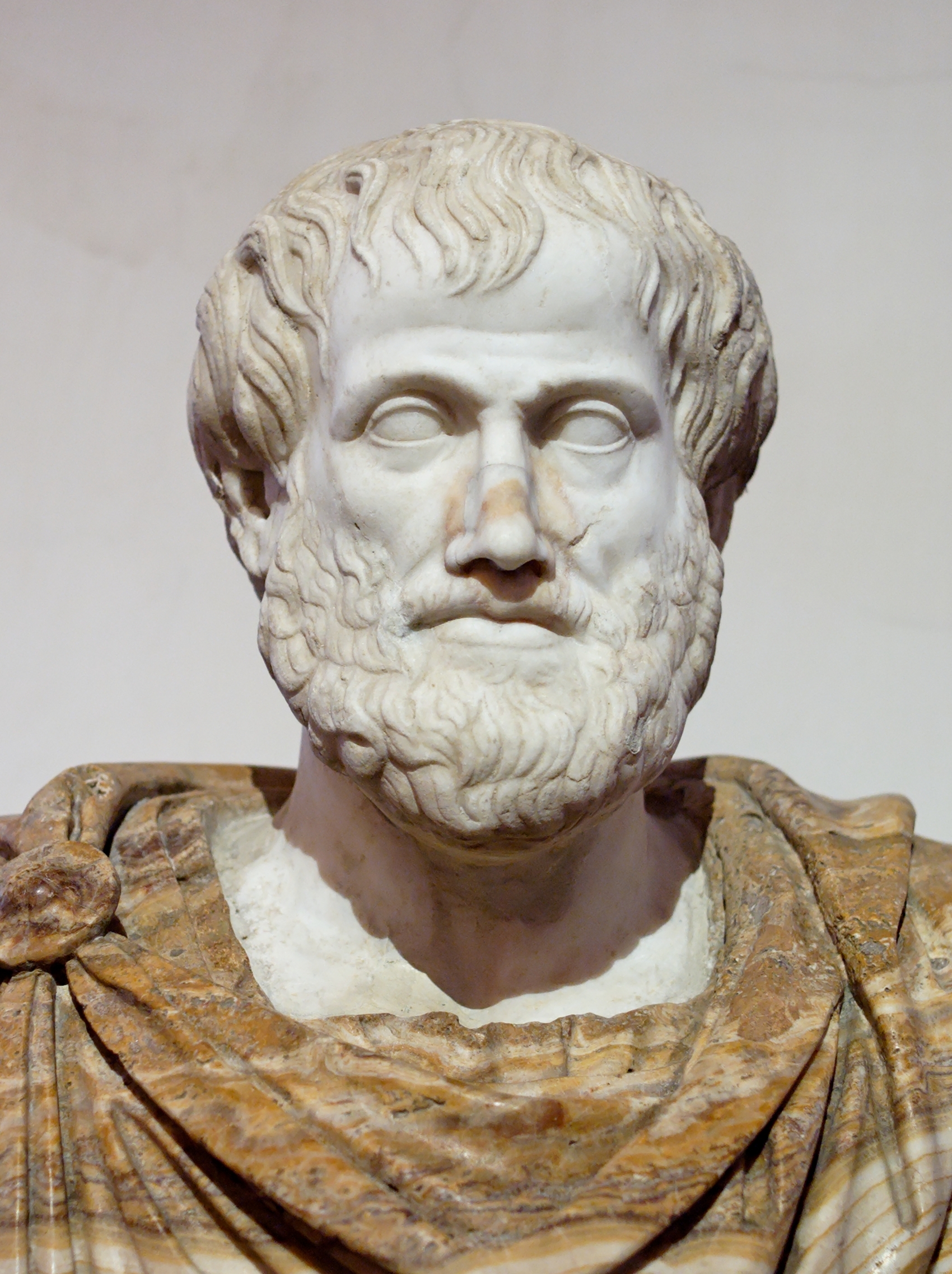
Public Domain
Back to archive
Full disclosure, I may occasionally borrow a sentence from Will Durant's Story of Civilization. I absolutely love that collection!