

The Bevatron and the Antiproton
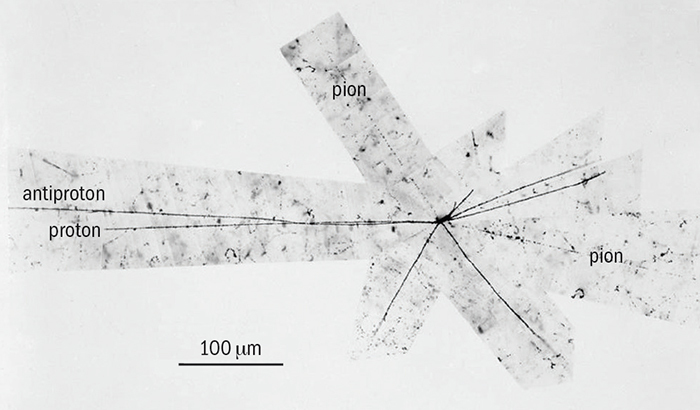
After World War II, the experimental physicists who had developed cyclotrons for electromagnetic isotope separation of uranium, now began to use synchrotrons to probe matter. The method was still the same as Chadwick had used to find the neutron, namely: a high-energy source, a target, and a detector. The first discovery of a new particle using synchrotrons was that of the Bevatron, at the Lawrence Berkeley Lab. They were specifically looking for the antiproton, having a threshold for generation sitting at about four proton masses (or 5.2 GeV), according to theory. In the case of the Bevatron, a combination of RF cavities and a large ring of copper coils and iron yokes were used to accelerate protons to about 6.2 GeV (6.2 billion-electron-volts, hence the name BeVatron). This proton beam would then hit a copper target and a spray of secondary particles would be sifted through a magnetic spectrometer—tuned to select negative particles of the right momentum and time-of-flight. The problem was that such a collision has many more chances of creating pions than antiprotons, about 1 antiproton per 40,000 pions. More specifically, what they were looking for was a pattern of particles they dubbed the annihilation star—a spray of eight outgoing pions (four positive and four negative) which was the expected outcome of an antiproton hitting another proton. On 21 September 1955, Segrè, Chamberlain and their group counted a total of 60 antiprotons produced during a run that lasted approximately 7 h. The idea of anti-matter was further proven.
Source: Yarris, Lynn. “Fifty Years of Antiprotons.” CERN Courier, November 2, 2005. link
Public Domain


Public Domain
Back to archive
Full disclosure, I may occasionally borrow a sentence from Will Durant's Story of Civilization. I absolutely love that collection!