

The Cyclotron
In the late 1920s, Ernest Lawrence developed the idea of a cyclotron. He later patented it in 1932. The device consists of a small flat circular vacuum chamber inside a magnetic field where an electric potential could be alternated from one half of the circular chamber to the other half. A charged particle sitting at the center of this chamber would feel the attraction towards one side (half) of the circle, but because of the constant background magnetic field its trajectory would be deviated tangentially. Then, if the alternating electric field is synchronized adequately, the particle would spin in an outward spiral trajectory—eventually leaving the chamber with a considerable energy. Cyclotrons had the advantage of being very compact. The first prototype could fit inside your back pocket; and the largest one ever built was only 152 cm in diameter—reaching a beam energy of 16 MeV. A major milestone in particle physics! However, the “appreciable variation in angular velocity” soon proved it obsolete—and instead, a similar idea (but at a much larger scale) superseded the cyclotron: the synchrotron…
Source: E. Lawrence, “Method and apparatus for the acceleration of ions,” US1948384 A, 20-Feb-1934
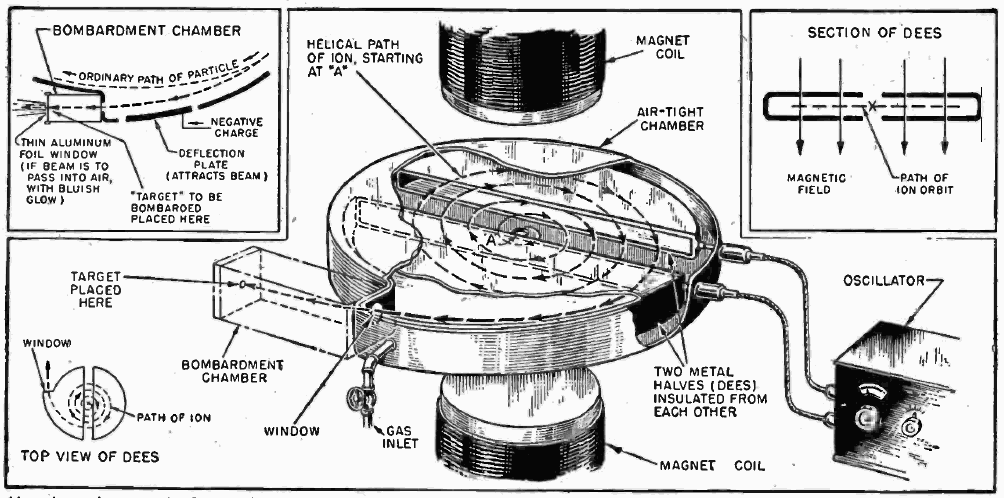
Public Domain
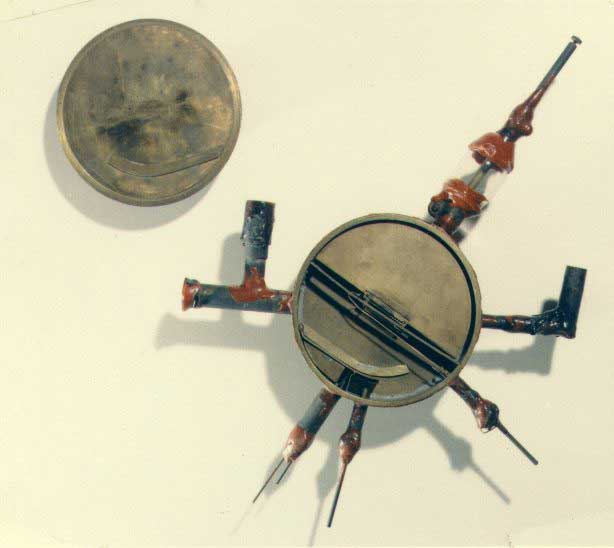
Public Domain
Back to archive
Full disclosure, I may occasionally borrow a sentence from Will Durant's Story of Civilization. I absolutely love that collection!