

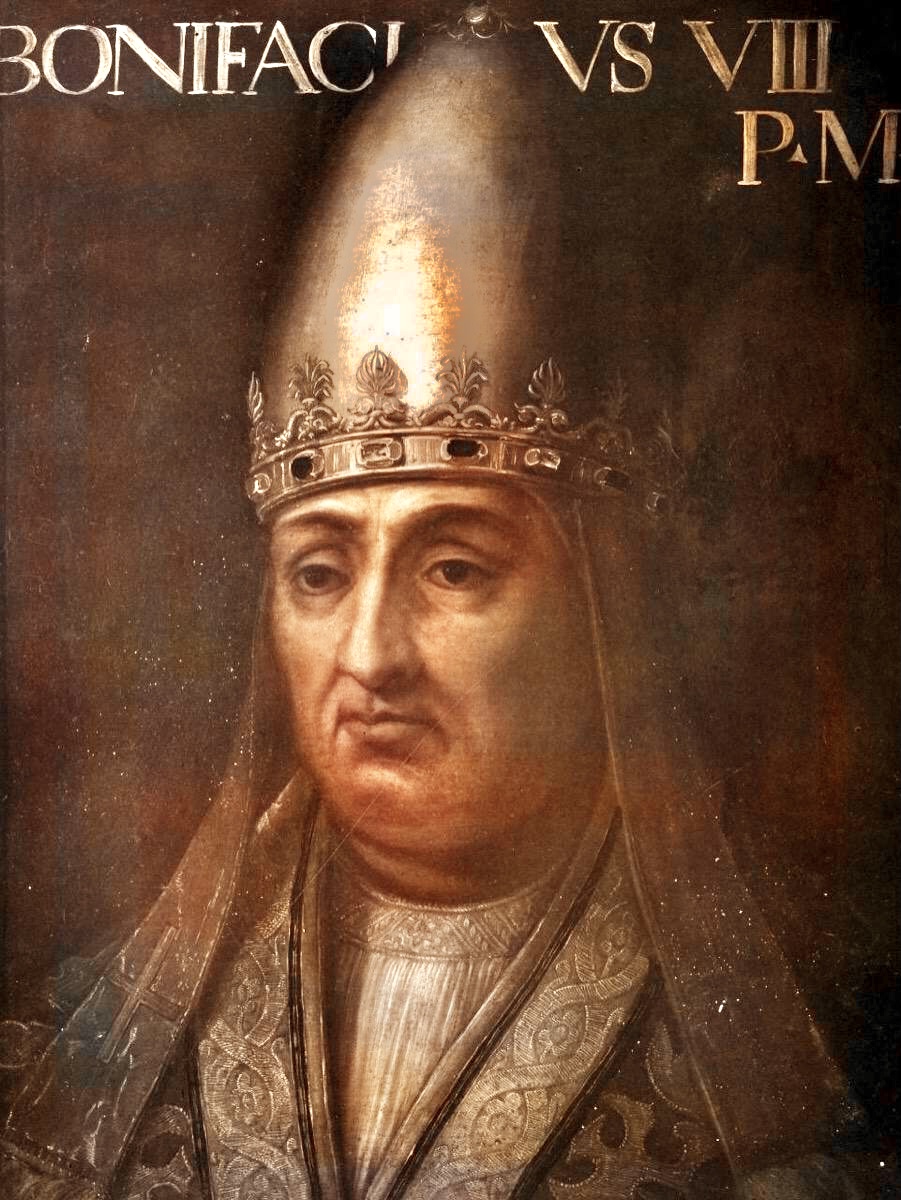
Boniface VIII
Nearly a century after Innocent III, came Boniface VIII (the tragic pope). He rose to the Papacy on Christmas eve in 1294—practically usurped it from Celestine V—right when the church was effectively the strongest government in Europe. It was a misfortune that Boniface’s love for the church was as strong as his imperfect morals, his personal pride, and his tactless will to power. His papacy was characterized by constant battles against the kings of Europe, as well as radical papal bulls such as the 'Clericis laicos' (1296), which effectively called for excommunication for taxation, or the ‘Unam sanctam’ bull (1302), declaring papal supremacy over secular rulers. Phillip IV of France responded by accusing the Pope as a tyrant, sorcerer, murderer, embezzler, adulterer, sodomite, simoniac, idolator, and infidel—and sent a group of mercenaries to confront him. They took Boniface prisoner in his own palace, where he perished from disease, stress, and/or torture. He became the tragic pope when he was posthumously accused of heresy in a trial where clergymen came out to condemn him. The testimony against Boniface, true or false, reveals the undercurrent of skepticism that was preparing to end the Age of Faith.
Source: Durant, Will. The Story of Civilization, Vol. 4: The Age of Faith, A History of Medieval Civilization, Christian, Islamic, and Judaic, From Constantine to Dante, A.D. 325-1300. New York: Simon and Schuster, 1950.
Public Domain
Back to archive
Full disclosure, I may occasionally borrow a sentence from Will Durant's Story of Civilization. I absolutely love that collection!