

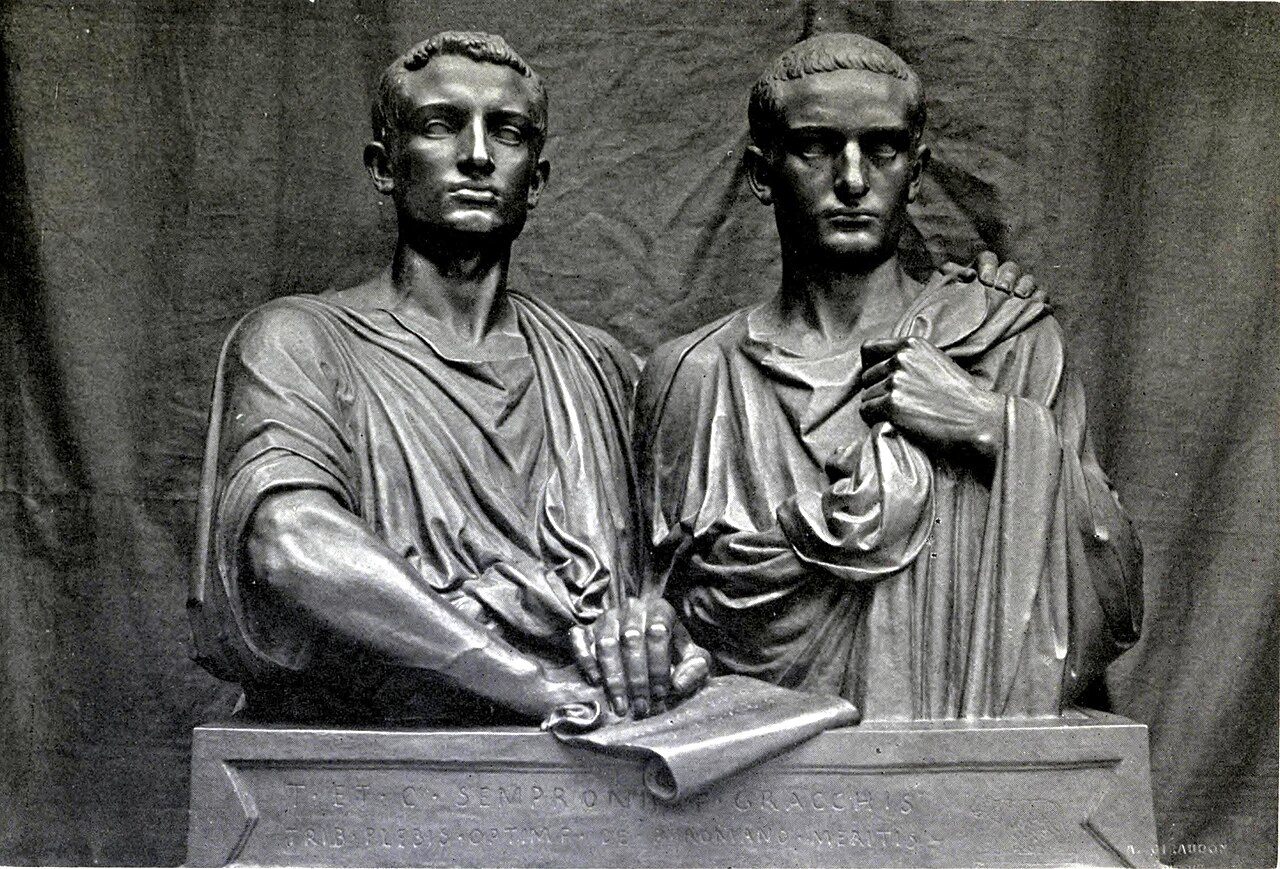
The Gracchi brothers
In 139 BCE the first Servile War began. This war kicked-off the path to Revolution which later intensified through Sulla and culminated with Caesar and the birth of the Empire. The Servile War was effectively an agrarian revolt that had three causes: 1) an influx of slave-grown corn from Sicily, 2) an influx of slaves that displaced peasants, and 3) latifundia; large farms that lowered labor costs and made it impossible for free workers to compete. A few years before the Servile War started, Tiberius Gracchus effectively declared his own war (of sorts) to the senate, by proposing an agrarian law that was destined to end in revolt. But the passing of this law came at the cost of his own life. Let’s back up. Tiberius and his brother Caius were the grandsons of Scipio Africanus, and whose sister later married Scipio Amelianus. The two brothers were almost equally ambitious, proud, sincere, eloquent beyond reason, and brave without stint. They knew both the problems of Roman government and the speculations of Greek thought. Tiberius asked himself, how could Rome preserve its leadership or independence if the sturdy peasants that had once filled its legions were displaced by desolate and alien bondsmen? How could Roman life and democracy ever be healthy with a city proletariat festering in poverty, instead of a proud yeomanry owning and tilling the land? He and his brother labored intensely to improve the conditions of the working man, and in 133 BCE Tiberius submitted three proposals to the Tribal Assembly: 1) that no citizen should be permitted to hold more than 333 acres of land bought or rented from the state; 2) that all other public lands that had been sold or leased to private individuals should be returned to the state for the purchase; and 3) that the returned lands should be divided into twenty acre lots among poor citizens. The proposal infuriated the senate, but it gained Tiberius so much popularity that when he was killed by a blow on the head, the Senate sought to mollify the bitter plebs by consenting to the enforcement of the Gracchan laws. It didn’t work as intended, but Caius continued the good fight. Over the years he developed the most constructive body of legislation offered to Rome before Caesar. The result of this experiment with socialism was the same as historically has almost always been: the benefits were expanded to include an ever larger portion of the population and those who enjoyed the benefits realized they were no longer willing to share them. Caius lost popularity, and with it, his title as Tribune. To avert violence, he retired to private life and counseled his followers patiently. Sadly, violence came to him instead; a reward for his head’s weight in gold was offered by the Senate. He fled across the Tiber; overtaken, he ordered his servant to kill him; the slave obeyed and then killed himself. A friend cut off Caius' head, filled it with molten lead, and brought it to the Senate.
Source: Durant, Will, The Story of Civilization, Vol. 3: Caesar and Christ, A History of Roman Civilization and of Christianity from Their Beginnings to A.D. 325, Simon and Schuster, 1944.
Public Domain
Back to archive
Full disclosure, I may occasionally borrow a sentence from Will Durant's Story of Civilization. I absolutely love that collection!