

Voltaic Pile
Around 1790, a fascinating rivalry of thought raged between Bologna (a Papal State) and Pavia (part of the Austrian Empire). The two cities were only 150 miles apart, but they were worlds apart politically. During the Italian Renaissance, Pavia had been infected with the germ of rational thought and by the eighteenth century this region was the center of the European Enlightenment. Bologna, on the other hand, was still trapped in the middle ages, assuming that the realm of God was separate and unexplainable. Out of these two radically different backgrounds, two brilliant experimental minds arose: Luigi Aloisio Galvani in Bologna, and Alessandro Volta in Pavia.
In a famous experiment that brought Galvani dangerously close to the edge of knowledge, a Hauksbee sphere was hooked up to a wire and to the exposed nerves of a dissected frog. The frog twitched! Unable to make a direct connection (of thought) between the sphere (man-made) and the frog (of divine creation), Galvani attributed this mysterious effect to something called Animal Electricity. Alessandro Volta denounced this hypothesis and claimed these two realms were one of the same. Hearing this, Galvani doubled down. He devised an experiment using wires alone—no Leyden Jar or a Hauksbee spheres—to make the frog twitch. It worked, and Galvani deduced that there must be a magical substance inside living things that is intrinsic and unique to living things. Feeling victorious, he published his book De Animali Electricitate, and sent Volta a copy. The Enlightened Volta set out to explain this phenomenon rationally.
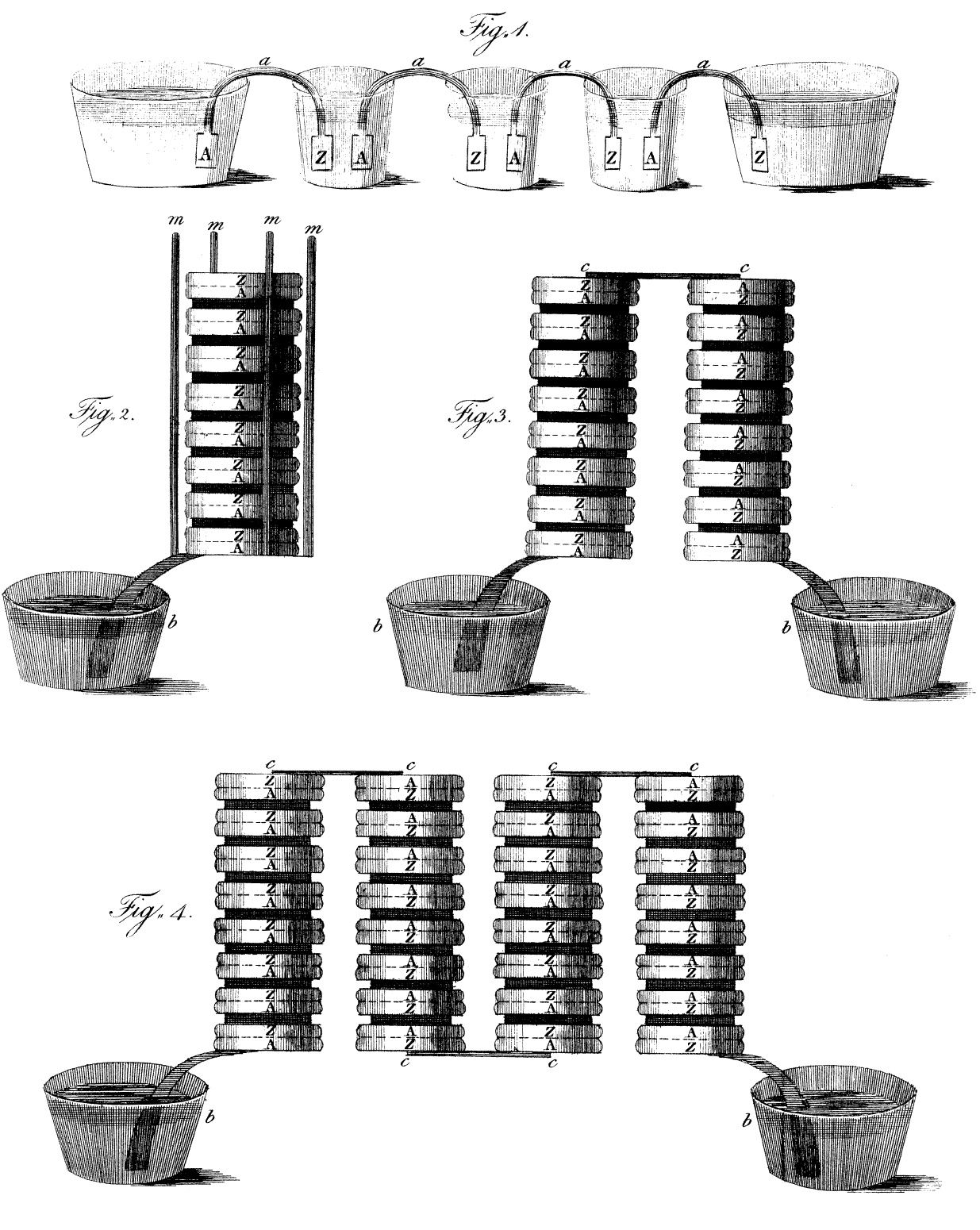
The first clue likely came out of one of Volta’s lectures in which he claimed that using different combinations of metals (coins and spoons) one could “taste electricity”. He deduced that the wires that Galvani was using perhaps caused a similar effect, and he set out to maximize it. The solution came to him while studying the work of Cavendish on the Torpedo Marmorata; Volta noticed the repeating pattern of chambers inside the fish, and was inspired to make a similarly repeating pattern of the spoon, coins, and tongue that he was demonstrating in his lectures. In 1799 he built his first “pila” using a repeating stack of copper layers, paper soaked in diluted acid, and layers of a dissimilar metal (likely nickel). The taste of electricity intensified... Suddenly all the phenomena of Animal Electricity was present in a completely man-made object. But the biggest reveal was that the electricity was continuous—it poured out like water on a stream—hence the term electrical current.
Source: Shock and Awe: The Story of Electricity. Presented by Jim Al-Khalili, BBC, 2015.
Public Domain
Back to archive
Full disclosure, I may occasionally borrow a sentence from Will Durant's Story of Civilization. I absolutely love that collection!