

The Second Crusade
In 1147, fifty years after the First Crusade, the Second Crusade threatened to better the example of the First—with Abbot of Cluny advising Louis VII not to annihilate "these accused beings" but to subject them to "fearful torments, and be preserved for greater ignominy, for an existence more bitter than death". Beyond tormenting infidels, the primary goal was to re-capture some of the cities in Palestine that had been taken by Islam and who were threatening the Kingdom of Jerusalem. On that excuse, the church was able to recruit both the king of France (Louis VII) and the Emperor of Germany (Conrad III). They advanced through Europe, reached Byzantium, and were received with much suspicion and caution. Here, the thought of taking Constantinople for themselves was mentioned in private for the first time—a seed was planted. Suspicious of each other, the two kings failed to bring a united front, and as they advanced, different factions and the resilience of the Muslim towns fractured their armies. When they arrived at Jerusalem, Conrad had only a pitiful remnant of what he had left Germany with and Louis had no soldiers, only a harem of women. An army was improvised with forces from Jerusalem and marched against Damascus. A siege was laid (see image). Poor leadership and a lack of discipline led to internal disputes which prompted the Muslim nobles to bribe many a Christian into inaction or retreat. When word came that the emirs of Aleppo and Mosul were sending reinforcements, the Christian army broke into fragments and fled to Antioch, Acre, or Jerusalem. Conrad, defeated and diseased, returned in disgrace to Germany. Louis remained another year in Palestine, making pilgrimages to sacred shrines.
Back to All Crusades
Source: Durant, Will, 1885-1981, The Age of Faith: A History of Medieval Civilization, Christian, Islamic, and Judaic, From Constantine to Dante, A.D. 325-1300. Simon and Schuster, 1950.
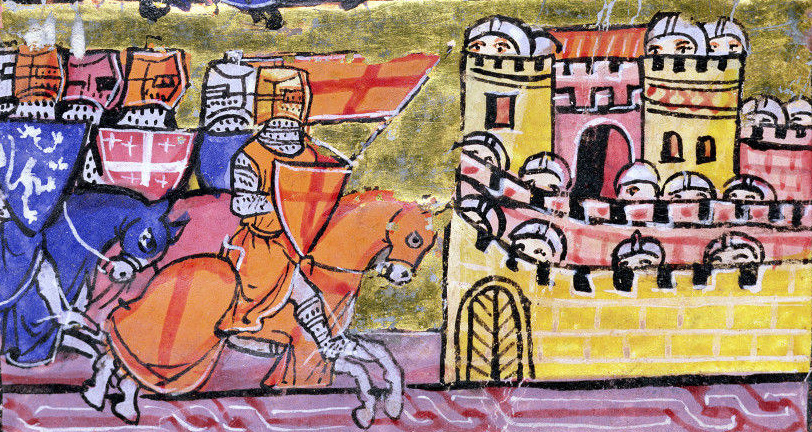
Public Domain
Back to archive
Full disclosure, I may occasionally borrow a sentence from Will Durant's Story of Civilization. I absolutely love that collection!