

The Death of Alexander
Between the first time Alexander met Darius III and the last, he took a side quest which started with the peaceful conquest of Damascus and Sidon, followed by a frustratingly long siege at Tyre. The ancient city resisted so long that when at last he captured it, Alexander lost his head and allowed his men to massacre eight thousand Tyrians, and to sell thirty thousand as slaves. Jerusalem surrendered quietly, and was well treated; Gaza fought untill every man in the city was dead and every woman raped. Then, the triumphant march of the Macedonians was resumed through the Sinai desert into Egypt, where the pliant priests crowned Alexander Pharaoh, and so eased the way for the Ptolemaic dynasty. Marching back into Asia, he finished Darius (331) and by the end of the year he had reached Susa. Hardly stopping to rest, he marched over mountains in the depth of winter to seize Persepolis. Here, again, his good judgment left him, and he burned the magnificent city to the ground. Still insatiate, he attempted now what Cyrus the Great had failed to accomplish—the subjugation of the tribes that hovered on the eastern borders of Persia. He conquered Sogdiana, Ariana, Bactriana, Bokhara, and many more. In the year 327 we find him passing over the Himalayas into India, but after crossing the Indus river, his soldiers refused to go farther. He pleaded with them, and for three days, like a scion of Achilles, pouted in his tent. At every new remove from Greece Alexander was becoming less and less a Greek, more and more a barbarian king. Similarly, his army, despite having conquered the Orient, was feeling like it was the Orient who had conquered them. From this tension, conspiracy rose; Alexander’s alcohol intake increased, and his angry paranoia finally exploded when he killed his friend Cleitus in a drunken rage by hurling a lance at him after an offensive comment was made. This was the beginning of the end for the young conqueror. Overcome with remorse, the King secluded himself for three days, refused to eat, fell into hysteria, and tried to end his own life. By 325, threatened by mutiny, he decided to return home, but not without attempting to conquer Arabia on the way. While the army was in Ecbatana, his dearest companion, Hephaestion, fell sick and died. Back in Babylon, he abandoned himself more and more to drink. Cold weather suddenly setting in, gave Alexander a fever that raged for ten days; he continued to give orders to his army and his fleet. On the eleventh day he died, being in the thirty-third year of his age (323). When his generals asked him to whom he left his empire he answered, “To the strongest…”
Source: Durant, Will, 1885-1981, The Life of Greece: A history of Greek government, industry, manners, morals, religion, philosophy, science, literature and art from the earliest times to the Roman conquest. Simon and Schuster, 1939.
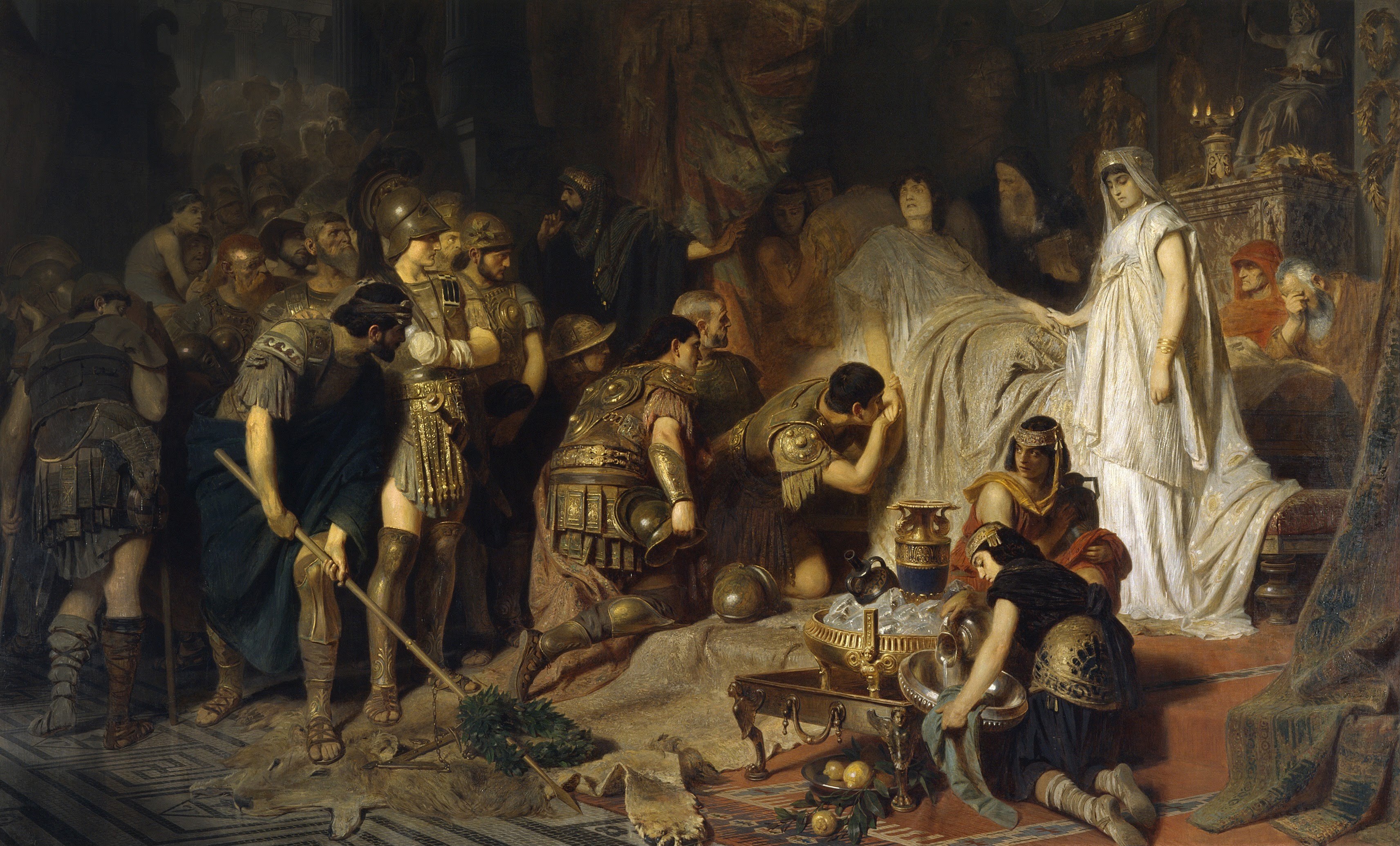
Public Domain
Back to archive
Full disclosure, I may occasionally borrow a sentence from Will Durant's Story of Civilization. I absolutely love that collection!