

Democritus of Abdera
Zeno’s pranks annoyed many, but they also got some people thinking about similarly ludicrous ideas. Among them, we have Leucippus (Zeno’s pupil) who developed the notion of the void or empty space, and Democritus (Leucippus’ pupil) most famous for naming the atom after the Greek word for ‘unable to cut’. Those who pursued similar ideas are now called "Materialists". They hoped to make Zeno’s impossible motion theoretically possible as well as sensibly actual—and Democritus is their most revolutionary thinker. It is with no malice that Francis Bacon called him the greatest of ancient philosophers; and Renaissance painter Donato Bramante (see image) admired him enough to paint one of the few portraits that exist of Leonardo da Vinci (as Heraclitus) next to Democritus, ‘The Laughing Philosopher’. Born in 460 BCE in Abdera, we are told he inherited 100 talents (~$8 million today) and spent most of it travelling the world. Having spent his money, he became a philosopher, lived simply, devoted himself to study and contemplation, and said he "would rather discover a single demonstration [in geometry] than win the throne of Persia”. He disliked women and children because they took time away from thinking. He journeyed to Athens to meet Socrates, but found himself too shy to introduce himself. Diogenes Laertius gives a long list of 73 books by Democritus in mathematics, physics, astronomy, navigation, geography, anatomy, physiology, psychology, psychotherapy, medicine, philosophy, music, and art—but none of these survive (in part thanks to Pato who ordered his books burned). He deduced correctly that the Milky way is made of stars, suggested the conservation of mass, described a multi-world universe, and hypothesized the atom—using methods of thinking that were knocking at the door of differential calculus. “Nothing exists but atoms and the void”. He also wrote extensively on ethics (“A man should feel more shame in doing evil before himself than before all the world”), about life and happiness (“A life without festivity is a long road without an inn.”), and about virtue (“strength of body is nobility only in beasts of burden, strength of character is nobility in man”). Finally, having lived long enough, he reduced his food each day, determined to starve himself by easy degrees. Diogenes Laertius, once again, describes the Philosopher’s death
“He was exceedingly old, and appeared to be at the point of death. His sister lamented that he would die during the festival of the Thesmophoria, which would prevent her from discharging her duties to the goddess. So he bade her be of good cheer, and to bring him hot loaves (or a little honey) every day. And by applying these to his nostrils he kept himself alive over the festival. But when the three days of the feast were passed he expired without any pain, as Hipparchus assures us, having lived one hundred and nine years.”
Source: Durant, Will, 1885-1981, The Life of Greece: A history of Greek government, industry, manners, morals, religion, philosophy, science, literature and art from the earliest times to the Roman conquest. Simon and Schuster, 1939.
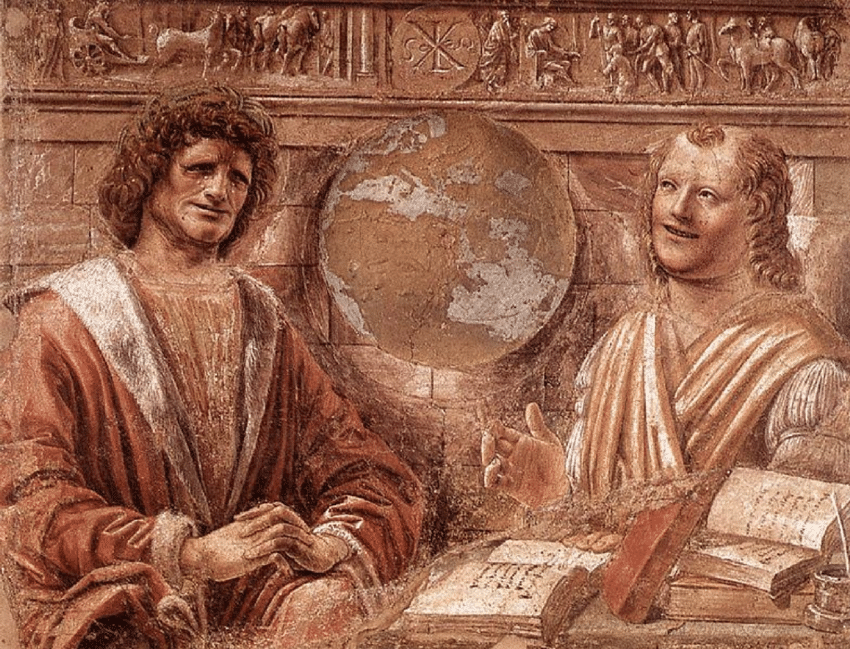
Public Domain
Back to archive
Full disclosure, I may occasionally borrow a sentence from Will Durant's Story of Civilization. I absolutely love that collection!