

Socrates
Socrates was born in Athens in 470 BCE. His mother was a midwife, and he joked that he was not the creator of reason, just the midwife, like his mother. History proved him right. His opponents were less gentle, claiming that he rejected every answer but gave none of his own. They were not wrong; he sprouted a thousand questions and answered none. Despite this, his followers saw him as “the wisest, and justest, and best of all the men”. Most of the stories that come down to us are from Plato and Xenophon, who describe him as a simple man who wore the same shabby robe throughout the year, and who was the “happiest of men” feeling himself rich in his poverty. One day, seeing all the hustle and bustle of an artisan’s market, he remarked “How many things there are that I do not want!”. We know he fought in the Peloponnesian war; saved a young Alcibiades during battle in Potidaea, and apparently was the last man standing at Delium. As for his philosophy, he considered himself an “amateur”, but happily instructed anyone who was willing to listen. His pupils differed so widely among themselves that they became the leaders of the most diverse philosophical schools and theories in Greece—Platonism, Cynicism, Stoicism, Epicureanism, Skepticism. Nonetheless, he refused to dogmatize and accepted only his ignorance. “For a life unscrutinized is unworthy of a man”. He didn’t explicitly deny the gods, he just sort of ignored them—leading a philosophical revolution that would undermine religious power—and for that he was to pay the ultimate price. “Good is not good because the gods approve of it, but that the gods approve of it because it is good”. Anytus, a general of the Peloponnesian war and later the leader of the democratic party, brought forth Socrates’ demise by blaming him for stirring an oligarchical revolution. In reality, Anytus resented Socrates because Alcibiades chose Socrates over him, because his son became a drunkard after listening to Socrates, and because like most philosophers, Socrates thought Democracy was a mistake. Through his trial, he defended himself as himself; making ridicule of the proposed statements and showing that virtue is man’s best weapon “You say first that I do not believe in gods, and then again that I believe in demigods. . .. You might as well affirm the existence of mules, and deny that of horses and asses”. “Either acquit me or not; but whatever you do, know that I shall never alter my ways, not even if I have to die many times”. The sentence of guilty was pronounced upon him by the small majority of sixty; had his defense been more conciliatory it is likely that he would have been acquitted. After he was gone, says Diodorus, the Athenians regretted their treatment of him, and put his accusers to death. With Socrates, The Golden Age of ancient Greece ended; and began its long decline.
Source: Durant, Will, 1885-1981, The Life of Greece: A history of Greek government, industry, manners, morals, religion, philosophy, science, literature and art from the earliest times to the Roman conquest. Simon and Schuster, 1939.
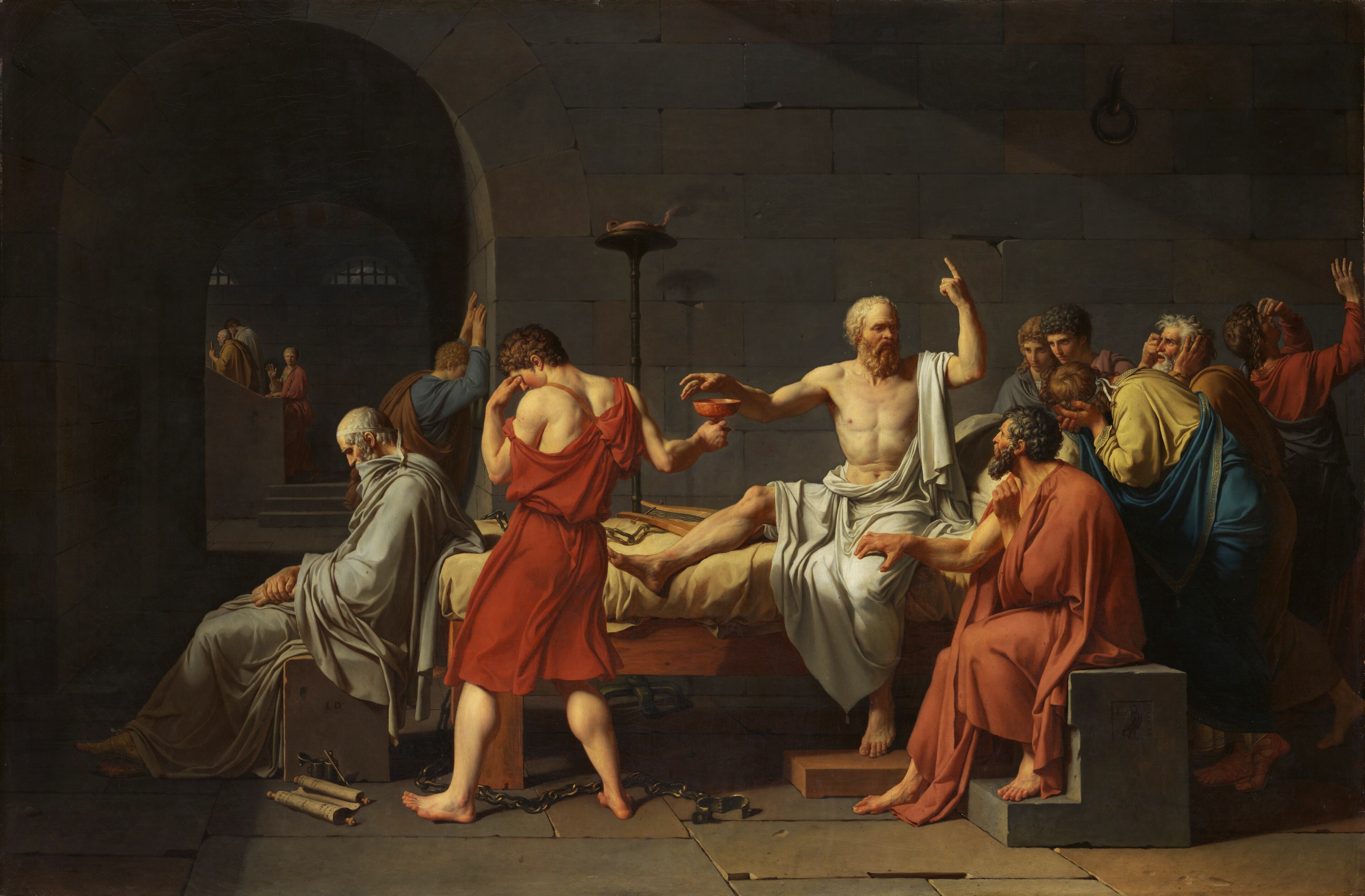
Public Domain
Back to archive
Full disclosure, I may occasionally borrow a sentence from Will Durant's Story of Civilization. I absolutely love that collection!