

Neo-Babylonian empire
The Old Babylonian Empire (which began with Hammurabi), disappeared almost in its entirety in 1595 BCE after the city was overthrown by the Hittite Empire from Asia minor. For almost a thousand years the city was controlled by the Assyrians, but in 626 BCE Nabopolassar allied with Cyaxares (the third king of the Medes) to destroy Assyria and establish a renewed Babylonia. This Neo-Babylonian empire only lasted 87 years, but its wealth and power left an important mark in the memory of men…
The seed of Babylon’s infamous reputation was sowed when Nabopolassar’s successor, Nebuchadnezzar II—the villain of the vengeful and legendary Book of Daniel—conquered and destroyed the Kingdom of Judah in 586 BCE and captured a large number Jews. This new Babylon, richer and more powerful than the old, was (according to Herodotus) surrounded by a wall fifty-six miles in length, and proudly displayed its riches and beauty through its landmarks—including the famous Ishtar Gate (after the goddess that fell in love with Gilgamesh), the Hanging Gardens (which the Greeks included among the Seven Wonders of the World), and a ziggurat taller than the Pyramids (which is suspected to be the famous Tower of Babel). The legend of a corrupt and immoral Babylon began with the Book of Daniel, it was ballooned by passages from a bewildered Herodotus, and was cemented after it fell to the Persians (when in 539 BCE Cyrus the Great took over). Even Alexander, who was not above dying of drinking, was shocked by the morals of Babylon. Nonetheless, Nebuchadnezzar’s Babylon does not seem more immoral or barbarous than any of the powerful governments of the ancient world. If anything, just not lucky enough to have its own historian tell the tale. The city lost its luster after Alexander’s generals founded the Seleucid Empire (312 BCE), and further declined in importance through nine centuries of Parthian and Sasanian Persian rule. Then, through the conquests of Christianity, the Turks, and the Muslims, it disappeared from history and only remembered mostly in folklore. Nonetheless, so deep was the memory of Nabopolassar’s short-lived, lavish, and ornate empire, that two thousand years later the tale was revived and reinforced by Petrarch (the father of the Renaissance) when he famously compared Avignon as the “impious Babylon, the hell on earth, the sink of vice, the sewer of the world”... [Avignon was where the papacy was temporarily moved after the debacle between Boniface VIII and Phillip IV and where corruption grew to unseen levels]. Since then, it has appeared in hundreds of poems and songs.
Source: Durant, Will, The Story of Civilization, Vol. 1: Our Oriental Heritage, A history of civilization in Egypt and the Near East to the Death of Alexander, and in India, China, and Japan from the beginning. New York: Simon & Schuster, 1954.
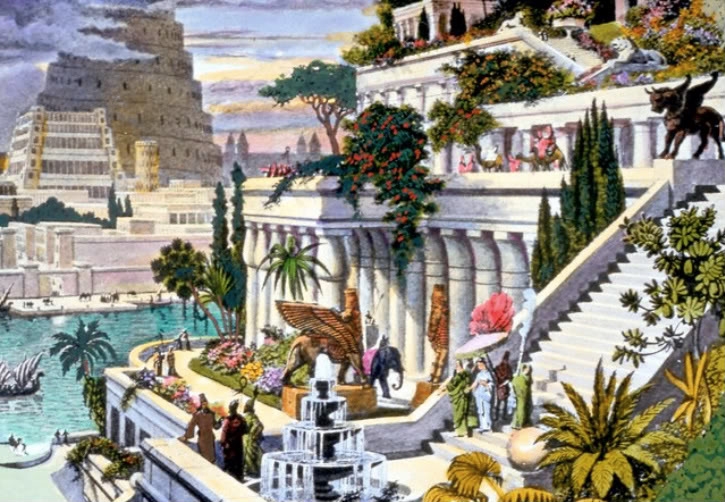
Public Domain
Back to archive
Full disclosure, I may occasionally borrow a sentence from Will Durant's Story of Civilization. I absolutely love that collection!