

The Empire
The longevity of Ancient Egypt is astonishing: The Old Kingdom lasted ~860 years and The Middle Kingdom ~570 years (with a ~500 year-long interlude between them). Then came the Hyksos invasion which lasted about 200 years. Soon, however, these invaders in their turn grew fat and prosperous, and lost control; the Egyptians rose in a war of liberation, expelled the Hyksos, and established that Eighteenth Dynasty which was to lift Egypt to greater wealth, power, and glory than ever before. This period of ancient Egypt is known as “The Empire”, and it lasted 480 years—starting with Thutmose I, who at the end of his thirty-year reign raised his daughter Hatshepsut to partnership with him on the throne. Hatshepsut eventually assumed full royal powers, and proved herself a king in everything but gender. She beautified the temple of Karnak (a series of temples that half a hundred Pharaohs took part in building), made Thebes and Luxor centers commerce, and on two slender nearby obelisks, she wrote:
These obelisks are of hard granite from the quarries of the South; their tops are of fine gold chosen from the best in all foreign lands. They can be seen from afar on the river; the splendor of their radiance fills the Two Lands, and when the solar disc appears between them it is truly as if he rose up into the horizon of the sky… You who after long years shall see these monuments, who shall speak of what I have done, you will say, "We do not know, we do not know how they can have made a whole mountain of gold."... To guild them I have given gold measured by the bushel, as though it were sacks of grain,...for I knew that Karnak is the celestial horizon of the Earth.”
During the Empire we also have Amenhotep II and Amenhotep III (who brought incredible wealth and power to Egypt), Akhenaten, the heretic king (whom we’ve met); as well as other famous Pharaohs like Tutankhamun, all the eleven Ramesses’ (including the 2nd), and the two Setis. Towards the end, in the reign of the last Ramessid king, the High Priest of Amon usurped the throne and ruled as openly supreme; the Empire became a stagnant theocracy in which architecture and superstition flourished, and every other element in the national life decayed. This kickstarted the thousand-year-long decline of Ancient Egypt: in 954 BCE the Libyans came in from the western hills, and laid about them with fury; in 722 BCE the Ethiopians entered from the south, and avenged their ancient slavery; in 674 BCE the Assyrians swept down from the north and subjected priest-ridden Egypt to tribute. In 525 BCE the Persians under Cambyses crossed Suez, and again put an end to Egyptian independence. In 332 BCE Alexander made Egypt a province of Macedon.... In 48 BCE Caesar arrived to capture Egypt's new capital, Alexandria, and to give to Cleopatra the son and heir whom they vainly hoped to crown as the unifying monarch of the greatest empires of antiquity. Finally, in 30 BCE Egypt became a province of Rome, and disappeared from history. Nonetheless, the fact that Egypt accomplished so much at the very dawn of history is worthy of reverence. “It is even possible,” as Élie Faure said, “that Egypt, through the solidarity, the unity, and the disciplined variety of its artistic products, through the enormous duration and the sustained power of its effort, offers the spectacle of the greatest civilization that has yet appeared on the earth.”
Source: Durant, Will, The Story of Civilization, Vol. 1: Our Oriental Heritage, A history of civilization in Egypt and the Near East to the Death of Alexander, and in India, China, and Japan from the beginning. New York: Simon & Schuster, 1954.
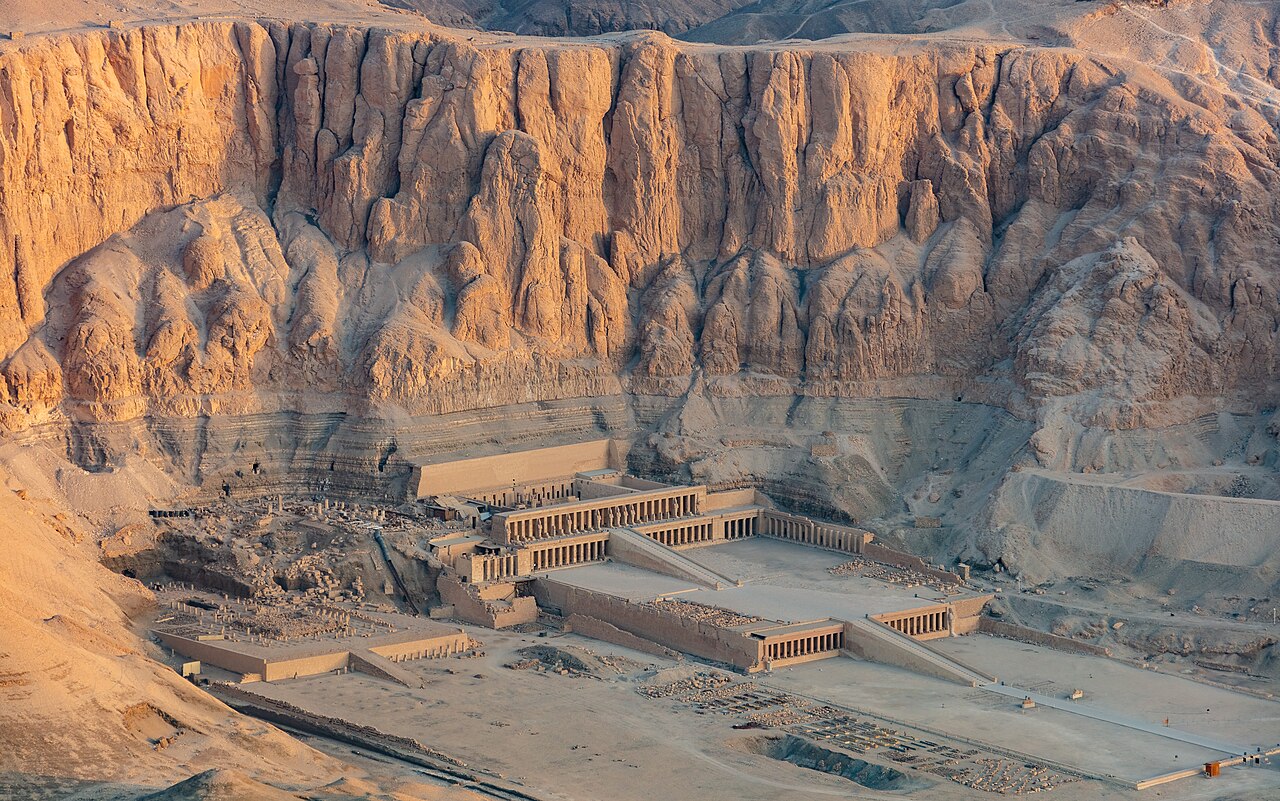
Image by Diego Delso under CC BY-SA 4.0 license
Back to archive
Full disclosure, I may occasionally borrow a sentence from Will Durant's Story of Civilization. I absolutely love that collection!