

Abbevillian culture
The dates of the first few “cultures” of human development are a little debatable, but the way archeologists have divided our pre-history gives the first of these segments the name of Abbevillian culture—which seems to have gone from the beginning of the homo sapiens to somewhere around 100,000 years ago. Again, dates are very debatable and often depending on the geographic region where the fossils were found. Nevertheless, in the first part of this period, the tools developed by early humans were mostly flints and stones used as nature provided them. The coup-de-poing or "blow-of-the-fist" stone—a rock sharp at one end and round at the other, to fit the palm of a hand—became for this primeval human hammer, Axe, chisel, scraper, knife, and saw; even to this day the word hammer means etymologically stone. Towards the end of the Abbevillian culture, the tools got slightly better by roughly flanking on both sides, pointing into the shape of an almond, and fitting it better to the hand.
Source: Durant, Will, The Story of Civilization, Vol. 1: Our Oriental Heritage, A history of civilization in Egypt and the Near East to the Death of Alexander, and in India, China, and Japan from the beginning. New York: Simon & Schuster, 1954.
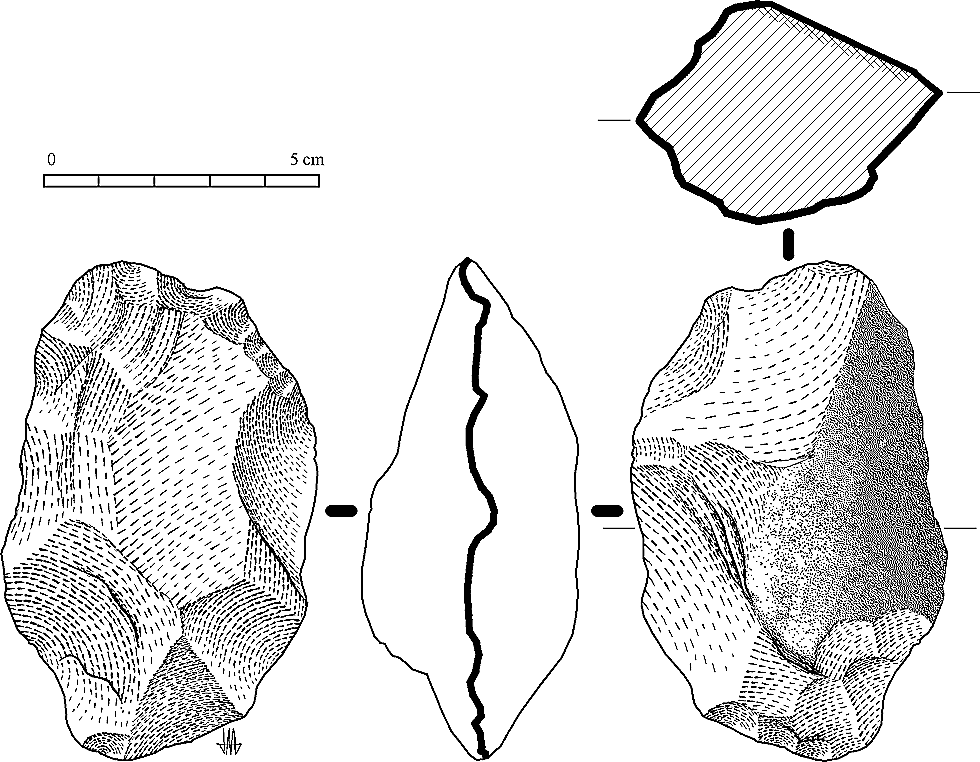
Image by José-Manuel Benito under CC BY-SA 2.5 license
Back to archive
Full disclosure, I may occasionally borrow a sentence from Will Durant's Story of Civilization. I absolutely love that collection!