

Hypatia
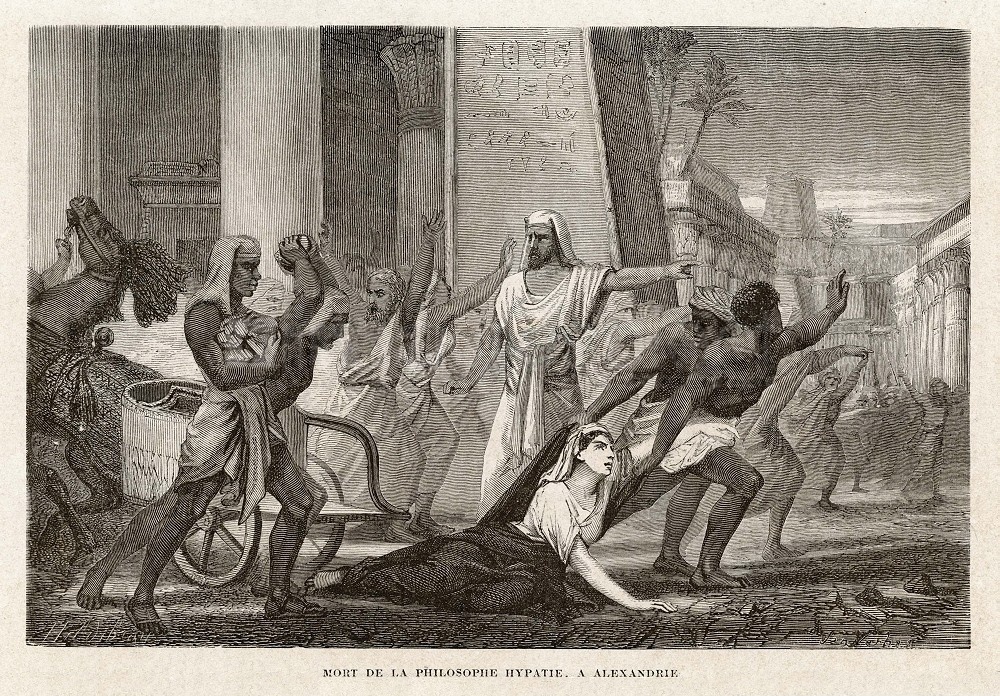
If we thought Rome had replaced the beaming light of Greek philosophy with something less worthy of the virtues of man, the mixture of barbarism and blind faith that came after the fall of Rome brought even more darkness. At the same time, if Eratosthenes was the rising Sun of the Library of Alexandria, Hypatia was the last light (born roughly 650 years after Eratosthenes, circa 350 CE). She was the chair of philosophy in the Alexandrian Museum, and wrote commentaries on Diophantus, on the Astronomical Canon of Ptolemy, and on the Conics of Apollonius of Perga. None of her works survived, but we hear of her charming lectures drawing large crowds and her ability to teach wherever and whenever a stranger asked a question. She commanded respect wherever she went; appearing before city magistrates and always raising awareness of the importance of the Library and its museum. But the admiration was not quite universal. Hypatia met a tragic end when a mob of fanatics—followers of Archbishop Cyril—stoned to death a prefect who had been influenced by Hypatia. This mob then turned to Hypatia (led by a "reader" or minor clerk on Cyril's staff), pulled her from her carriage, dragged her into a church, stripped her of her garments, battered her to death with tiles, tore her corpse to pieces, and burned the remains in a savage orgy. “An act so inhuman," says another (Cristian) Socrates, that it “could not fail to bring the greatest opprobrium not only upon Cyril, but also upon the whole Alexandrian church.”
Source: Durant, Will, 1885-1981, The Age of Faith: A History of Medieval Civilization, Christian, Islamic, and Judaic, From Constantine to Dante, A.D. 325-1300. Simon and Schuster, 1950.
Public Domain
Back to archive
Full disclosure, I may occasionally borrow a sentence from Will Durant's Story of Civilization. I absolutely love that collection!