

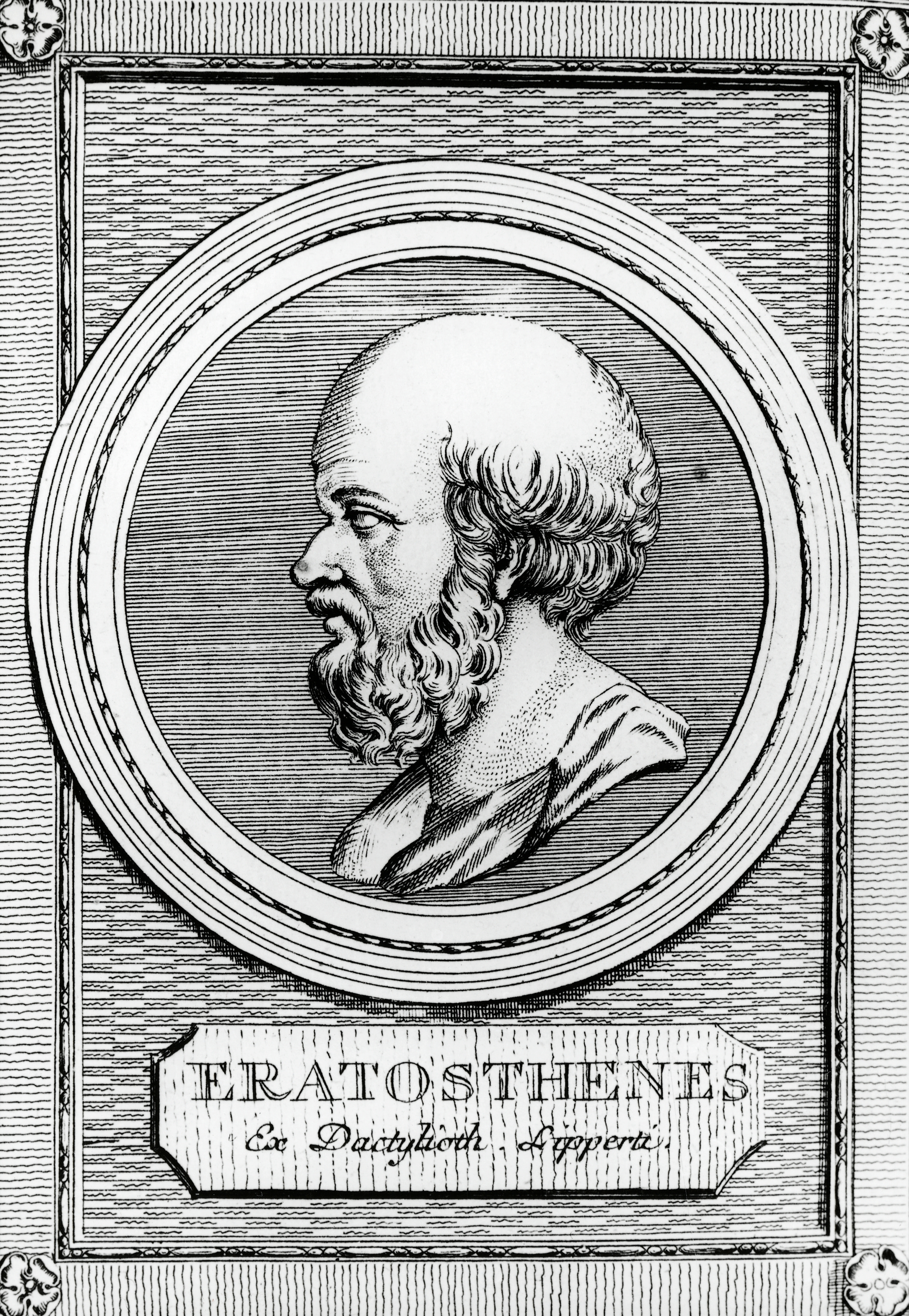
Eratosthenes of Cyrene
In 276 BCE Eratosthenes of Cyrene was born. It is said that he earned the nickname Beta, because his range was so wide that he ranked second on every field—only surpassed perhaps by those who dedicated their whole life to a single field of study. He had exceptional teachers: Zeno the Stoic, Arcesilaus the skeptic, Callimachus the poet, Lysanias the grammarian. By the age of forty his reputation for varied knowledge was so great that Ptolemy III made him head of the Alexandrian Library. His greatest achievement was his calculation of the Earth's circumference with an error of 0.7% by measuring the length of the shadows cast by sticks in different cities on equinox days—and paying his assistant to pace the distance between Alexandria and Syene. His most timeless passage reads: “If the extent of the Atlantic Ocean were not an obstacle, we might easily pass by sea from Iberia (Spain) to India, keeping in the same parallel.” Having measured the Earth, he proceeded to describe it in his book Geographica by compiling many reports from Alexander's surveyors and describing the climates of many places. He is also the first western geographer to mention the Chinese. But he was not just a scholar, he was a humanist too, admonishing the Greeks to abandon their provincial division of mankind into Hellenes and “barbaroi”. For, he reasoned, many Persians and Hindus were refined, and the Romans had shown a greater aptitude than the Greeks for social order and competent government. In a sense, he anticipated the fall of Greece and the rise of Rome.
Source: Durant, Will, 1885-1981, The Life of Greece: A history of Greek government, industry, manners, morals, religion, philosophy, science, literature and art from the earliest times to the Roman conquest. Simon and Schuster, 1939.
Public Domain
Back to archive
Full disclosure, I may occasionally borrow a sentence from Will Durant's Story of Civilization. I absolutely love that collection!