

Pythagoras
The great Pythagoras was born in Samos, but left it in 529 to live in Crotona, Italy. His most famous contribution (the Pythagorean theorem) was but the tip of the iceberg of the things that are attributed to him. According to Diogenes Laertius, Pythagoras "was the first person to call the earth round, and to give the name of kosmos to the world". The very word "philosophy" is apparently one of his creations. He was sort of a cult leader; the members of his school bound themselves by a vow of loyalty, both to the master and to one another. They were not to eat flesh, or eggs, or beans. It was a communistic group: men and women pooling their goods, educated together, trained to virtue and high thinking by mathematics, music, and philosophy, and offering themselves as the guardian rulers of the state. Indeed it was Pythagoras' effort to make his society the actual government of his city that brought ruin upon himself and his followers. The initiates entered so actively into politics, and took so decidedly the aristocratic side, that the democratic or popular party of Crotona, in an ecstasy of rage, burned down the house in which the Pythagoreans were gathered, killed several of them, and drove the rest out of the city.
The man certainly was much more than just a mathematician, but over the centuries his influence turned arguably too much on the mystic side—generating an obsession about the ‘regular’ solids, and encouraging philosophers to refrain from using their hands (or performing experiments), and instead, learning by thinking. Eventually this idea led to a disconnection of the body and the mind. Pato for example, an admirer of Pythagoras, urged astronomers to think about the heavens but not to waste their time observing them. This notion also separated the workers from their masters. All in all, controversial as his influence may be, Pythagoras was the founder of both science and philosophy in Europe (so far as we know them)... an achievement sufficient for any man.
Source: Durant, Will, 1885-1981, The Life of Greece: A history of Greek government, industry, manners, morals, religion, philosophy, science, literature and art from the earliest times to the Roman conquest. Simon and Schuster, 1939.
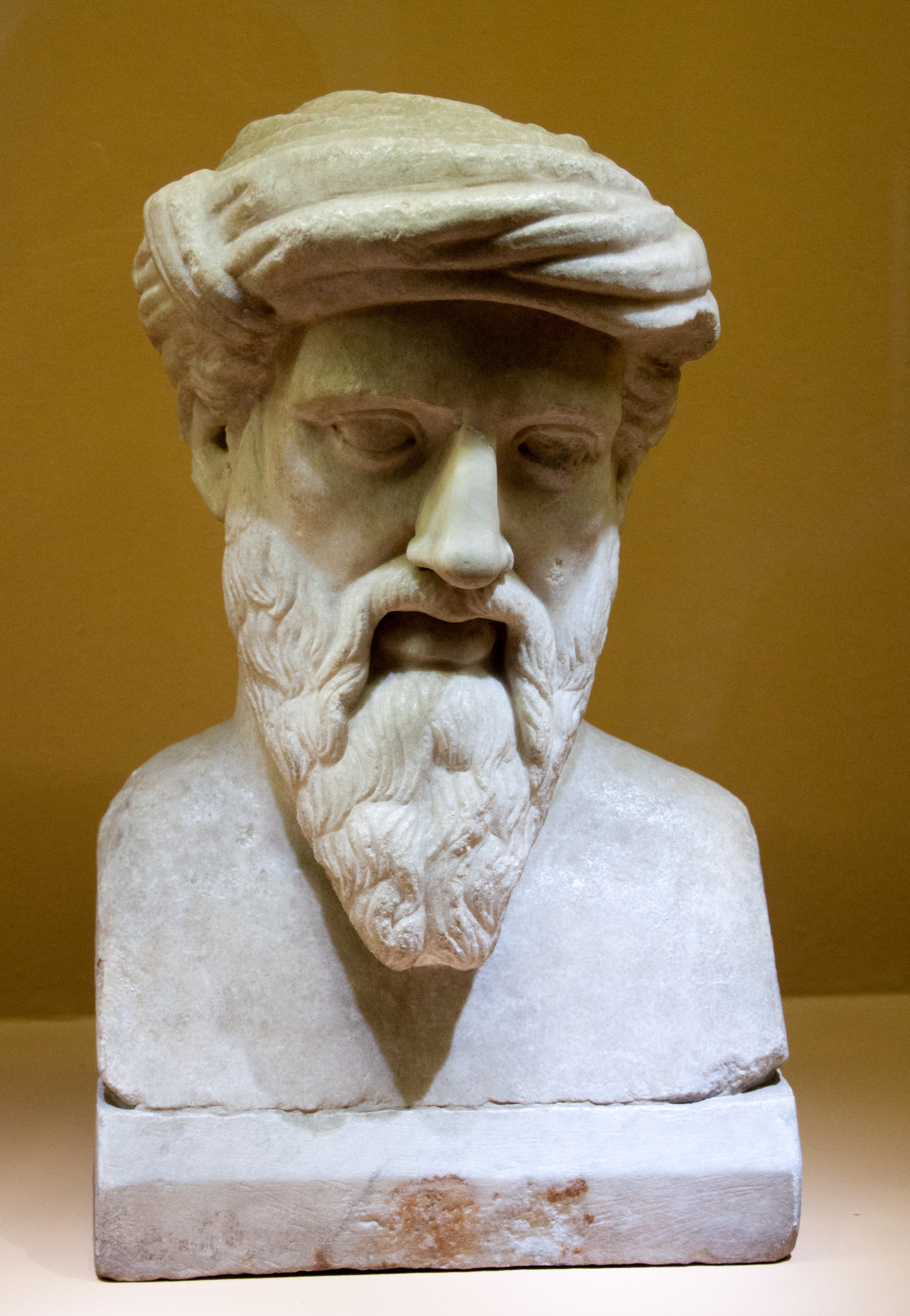
Public Domain
Back to archive
Full disclosure, I may occasionally borrow a sentence from Will Durant's Story of Civilization. I absolutely love that collection!