

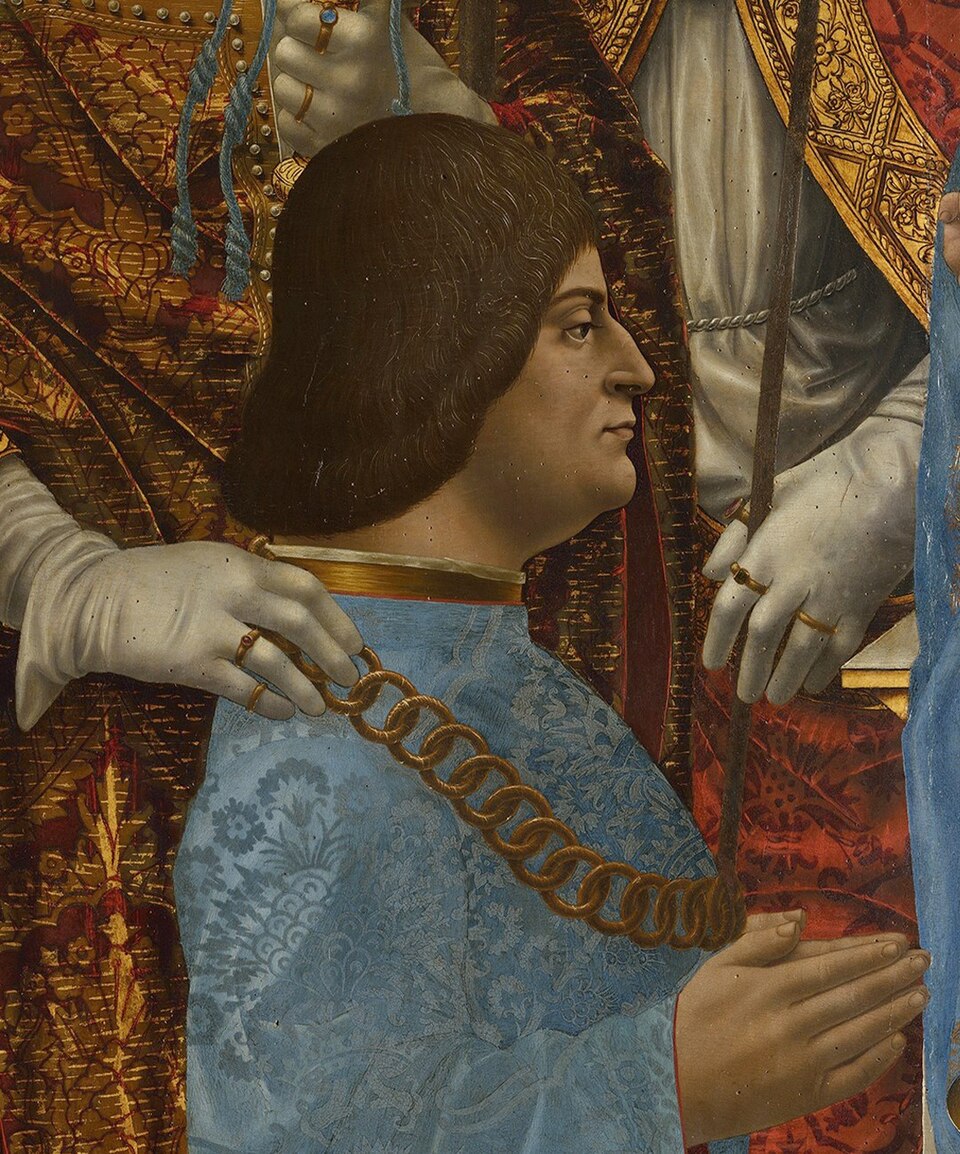
Ludovico Sforza rules Milan
The Florentine Renaissance effectively ended with the death of the last of her masters, Andrea del Sarto, in 1530. But even before it ended—through Savonarola's Revolution and the aftermath of its failure—many of the artists who had come to Florence to learn her lore and form their styles fled from her turbulence and lent their renown to other scenes. Some of them were looking for the spoils of political dominance, others looked for stability, but above all, they were all looking for immortality. For one particularly bright decade (1490s), Milan took the baton from Florence through the leadership of Ludovico Sforza "the Moor", and left an indelible dash in the history of the Renaissance. Ludovico's rise to power was unusual: his father, Francesco, had married his way to the throne after gaining the trust (and the daughter) of Filippo Maria Visconti—whose family had ruled Milan since the 1380s. Ludovico's brother succeeded their father, and after his brother's death the next in line was Ludovico's nephew. This seven-year-old heir apparent gave himself to amusement or idleness, and gladly left the administration of the state to the uncle whom he admired with envy and trusted with doubt. Under Ludovico's leadership, Milan prospered as not even under the best of the Viscontis—and while Florence trembled before Savonarola and burned the vanities of love and art, music and loose morals reigned in Ludovico's capital. His reputation and his unrivaled court attracted supreme artists like Bramante, Leonardo, and Caradosso. All these skilled men may have found immortality and/or political power, but they did not find stability... Together with his wife, Ludovico conspired to seize the official title of Duke; he also conspired with the French king and allowed him to pass unhindered on his way to conquer Italy (to the Moor's benefit). But while the French marched south, his nephew died of a combination of ailments, and Ludovico was wrongly suspected of poisoning him. The haste with which he had himself invested with the ducal title, did not help assuage the rumors (1495). And meanwhile, the Duke of Orleans invaded Italy with a second French army, announcing that he was a descendent of the Visconti and therefore deserved to rule Milan. Ludovico saw now that he had made a tragic error in welcoming the French King. Swiftly reversing his policy, he helped to form, with Venice, Spain, Alexander VI, and Maximilian, a "Holy League" to expel the French from the peninsula. Amid all this, his wife died (age 21), and everything began to crumble. His funds began to run out, and he fell behind in paying his troops. He was finally captured by the French (1500) and imprisoned in the castle of Lys-Saint-Georges in Berry. He accepted his fate quietly—merely asking for his personal copy of The Divine Comedy—but a few years after he was transferred to the chateau of Loches he tried to escape (1508). He was deprived of books and writing materials, and was confined in a subterranean dungeon. There, on May 17, 1508, in a dark solitude all the world away from the bright life of his once gay capital, Ludovico, aged fifty-seven, died.
One of Italy's greatest historians, Girolamo Tiraboschi, said some two centuries ago: "we feel inclined to pronounce him the best prince that ever lived."
Source: Durant, Will. The Story of Civilization, Vol. 5: The Renaissance, A History of Civilization in Italy from the Birth of Petrarch to the Death of Titian, 1304–1576. New York: Simon and Schuster, 1953.
Public Domain
Back to archive
Full disclosure, I may occasionally borrow a sentence from Will Durant's Story of Civilization. I absolutely love that collection!