

Victor Hess and Cosmic Radiation
Throughout the 19th century (dominated scientifically by Michael Faraday, James Clerk Maxwell, Lord Kelvin, and others), the excitement about magnetism made the study of electric fields take a lesser plane. One instrument in particular, the electroscope (developed in the 18th century), had been a mere curiosity up until the 1900s—with little to no use. Interestingly, as far back as Coulomb (c. 1785) it was noticed that the electroscope could spontaneously discharge. Later on, Crookes (c. 1880) observed that an electroscope could discharge faster when in vacuum. Later still, Becquerel and Curie pointed out that radioactivity also increases the discharge rate of the electroscope. People had begun to pay attention to electric fields again. But the mechanism itself—ionization of the gas particles between the electroscope sheets by alpha particle collisions—was not explicitly understood. Nonetheless, by the 1910s electroscopes were commonly used to measure radioactivity. The humble device had found its use over 150 years after its invention. In that first decade of the 20th century, several independent scientists also noticed that the natural rate of discharge (without radioactive materials around) could be prolonged if the electroscope was surrounded by shields of metal, almost as if there were radioactive emissions in the atmosphere. Where were these coming from? In reviewing the literature, Karl Kurz concluded in 1909 that this radiation could be coming from extra-terrestrial sources (possibly from the Sun), from the crust of the Earth, and/or from the atmosphere itself—but he dismisses an extra-terrestrial source as “unlikely”. Multiple scientists tried to confirm either of these sources by measuring from high places (such as the top of the Eiffel Tower), out in open sea, under water, and even using balloons. However, despite some of these results pointing to particles of cosmic origin, the scientific community was not ready to give up the Earth’s crust as the main suspect. The person who settled the matter was Victor Hess, who from April 1912 to August 1912 flew seven times on a balloon, armed with measurement instruments including the electroscope, and unequivocally showed that the radiation increased dramatically with altitude. He had shown that the strange particles being emitted from radioactive sources were the same as those coming from the sky. This was an astonishing revelation, and hardly the first discovery in particle physics that literally fell from the sky
Source: Hess, V. F. Über Beobachtungen der durchdringenden Strahlung bei sieben Freiballonfahrten. Physikalische Zeitschrift 13, 1084–1091 (1912).
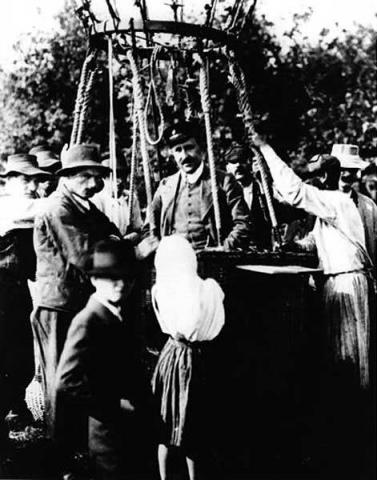
Public Domain
Back to archive
Full disclosure, I may occasionally borrow a sentence from Will Durant's Story of Civilization. I absolutely love that collection!