

The Council of Nicaea
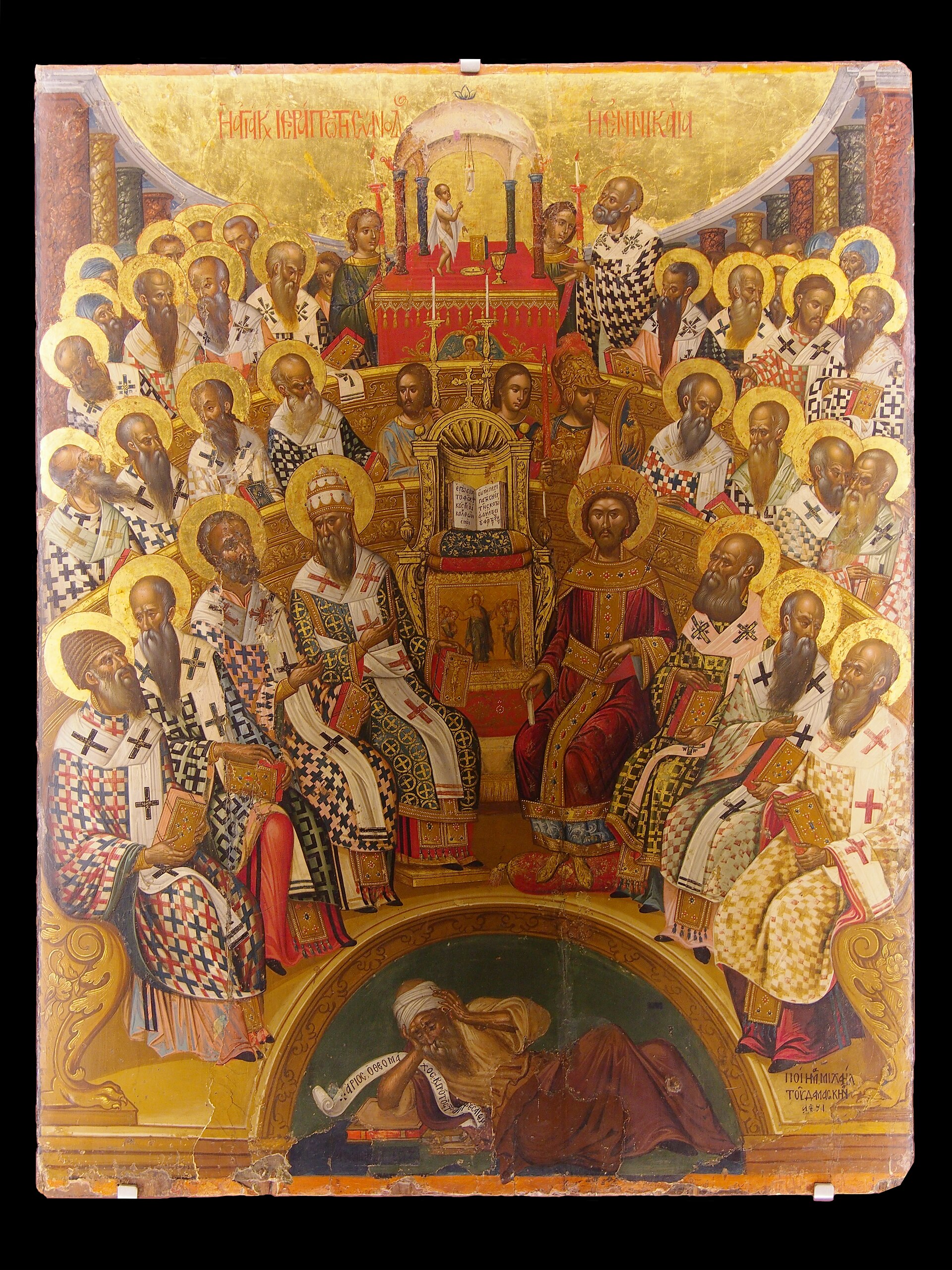
In 325, the Council of Nicaea took place. This was a meeting of hundreds of bishops (convened by Emperor Constantine) as an attempt by the Roman Catholic Church to settle the dispute whether Jesus was coeternal or consubstantial with God. The debate had been going on for a while and would go on for half a century more through Athanasius (supporter of the consubstantial idea) and Arius (favoring coeternal but separate)—leading to many factions and bloody consequences. In the end, the consubstantial argument won, partly because Arius died a violent death by shitting his intestines out in public (c. 336)—making people (including Constantine) wonder whether Arius had been a heretic after all—and partly because of Athanasius' patient diplomacy and eloquent vituperation though the years after Arius' death. But it was a hard won victory, with a particularly horrible couple of years between 342 and 343 in which more Christians died by the hands of Christians (as a result of this dispute) than by any Pagans in the history of Rome. By 373 the debate was settled, and it marked the moment when the Roman Empire and the Church became inseparable. To Athanasius, above all, Christianity owes the doctrine of the Trinity.
Source: Durant, Will. The Story of Civilization, Vol. 4: The Age of Faith, A History of Medieval Civilization, Christian, Islamic, and Judaic, From Constantine to Dante, A.D. 325-1300. New York: Simon and Schuster, 1950.
Public Domain
Back to archive
Full disclosure, I may occasionally borrow a sentence from Will Durant's Story of Civilization. I absolutely love that collection!