

Leo "The Isaurian"
Between 673 and 678 CE, the Byzantine empire saved itself from Arab invasion through five crucial years thanks to "Greek fire", an incendiary mixture of naphtha, quicklime, sulphur, and pitch. The composition of the mixture was a secret successfully guarded for two centuries by the Byzantine government. Another attempt from the Arabs to take Constantinople happened in 717, when a combined force of Persian and Arabs commanded under the leadership of Maslama ibn Abd al-Malik marched against Byzantium. Through brilliant tactics and clever use of Greek fire, emperor Leo "The Isaurian" won so decisive a victory that al-Malik withdrew to Syria. Through his victory, Leo saved Constantinople and Europe from Muslim conquest. It marked yet another instance during the Middle Ages where the chances of battle could have given us a very different world had they swung the other way (see 846 CE). Leo was an unusual emperor. He was born in Isauria, in Cilicia—hence his cognomen—and in his infancy he was given as a present to Emperor Justinian II. Early in his life, he became a guardsman of the palace, then commander of the Anatolian legions, finally, by the convincing suffrage of the army, emperor. As a statesman he gave the Empire the stability of just laws justly enforced, reformed taxation, reduced serfdom, extended peasant proprietorship, distributed lands, repopulated deserted regions, and constructively revised the laws. He is also known for pushing the iconoclastic movement: the prohibition of images of Christian saints out of the fear of being re-conquered by Paganism. Little did he know that the veneration of lesser saints (with the acknowledgement of a superior all-powerful god) was one of the best medicines Christianity had against the memory of polytheism—so vividly ingrained in the peoples of Europe—providing relief to the sectarian nature of the human mind.
Source: Durant, Will. The Story of Civilization, Vol. 4: The Age of Faith, A History of Medieval Civilization, Christian, Islamic, and Judaic, From Constantine to Dante, A.D. 325-1300. New York: Simon and Schuster, 1950.
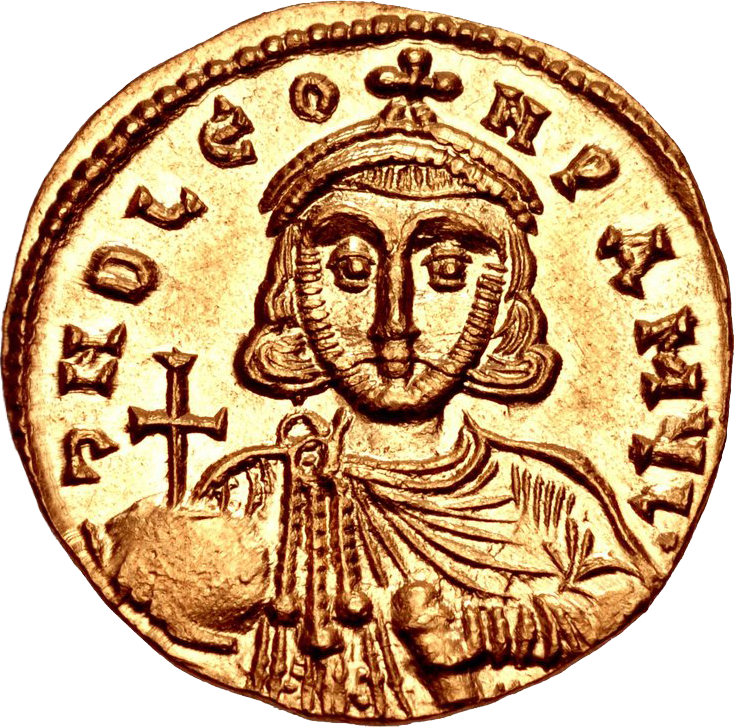
Image by the Classical Numismatic Group, Inc. under CC BY-SA 2.5 license
Back to archive
Full disclosure, I may occasionally borrow a sentence from Will Durant's Story of Civilization. I absolutely love that collection!