

Julian the Apostate
On June 27th, 363, Julian the Apostate, the last non-Christian Emperor of Rome, died at age 32 during his campaign against Persia. Shappur II (Persian King) outwitted Julian when he chose two Persian nobles, cut off their noses, and bade them go to Julian in the guise of men who had deserted because of this cruel indignity. They obeyed; Julian trusted them, and followed them, with his army, for twenty miles into a waterless waste. A surprise attack ended with a javelin entering his side and piercing Julian's liver. He died talking to his philosopher friends about the nobility of the soul. Three months before his death, he set out to conquer Persia and got as far as Ctesiphon. His dream was to rival Alexander and Trajan by planting Roman standards in the Persian capitals, and to end the Persian threat to the Roman empire. He didn't get to do this, but in his lifetime he was compared to Trajan as a general, to Antonius Pius as a saint, and to Marcus Aurelius as a philosopher-king. He was the only surviving nephew of Constantine and although his ascendence to the throne was improbable, he became and able general, a successful administrator—and as a Pagan, he won the hearts of Christians, Jews and the whole empire until his fame "filled the whole world".
Source: Durant, Will. The Age of Faith: A History of Medieval Civilization, Christian, Islamic, and Judaic, From Constantine to Dante, A.D. 325-1300. New York: Simon and Schuster, 1950.
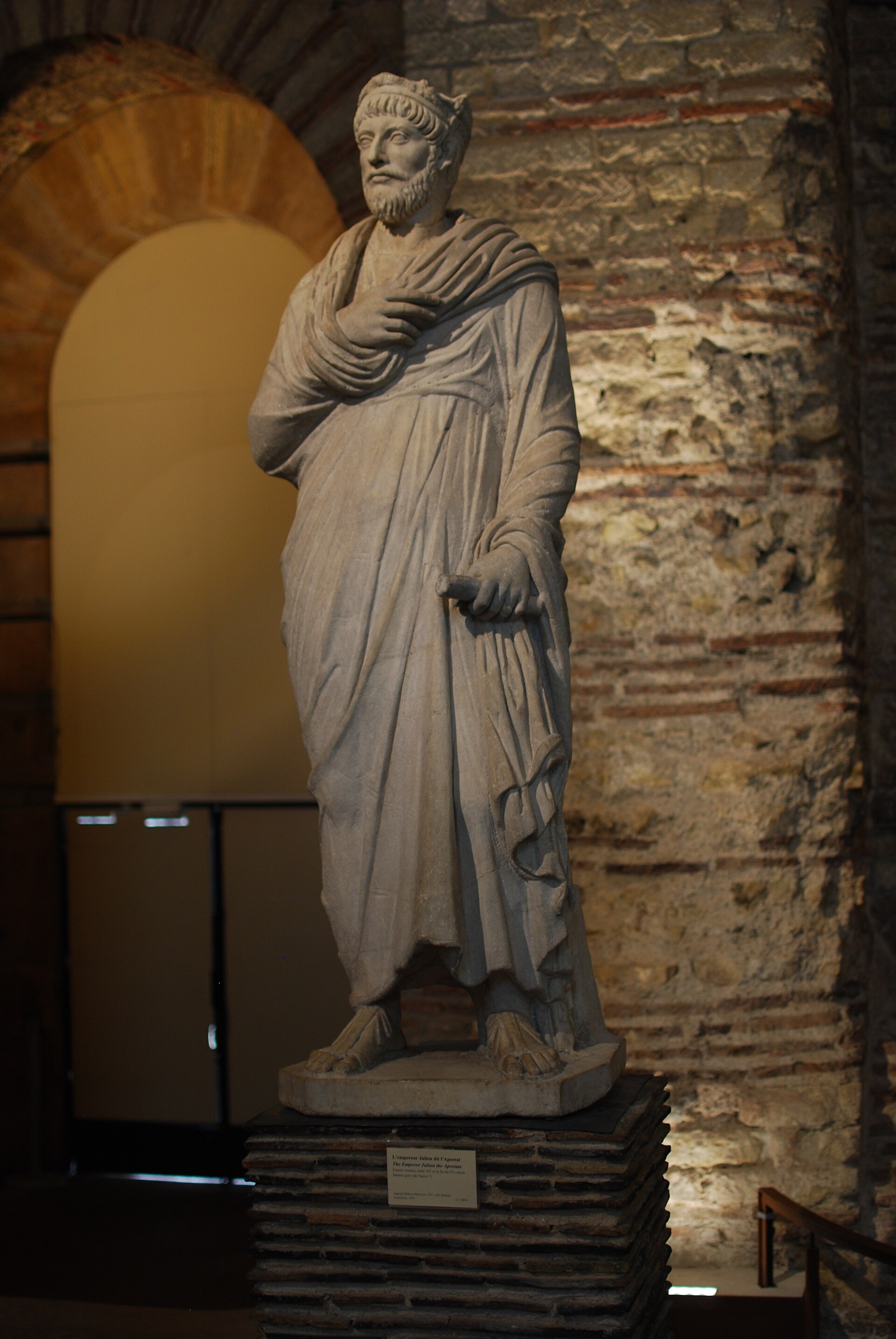
Image by Ash Crow under CC BY-SA 4.0 license
Back to archive
Full disclosure, I may occasionally borrow a sentence from Will Durant's Story of Civilization. I absolutely love that collection!