

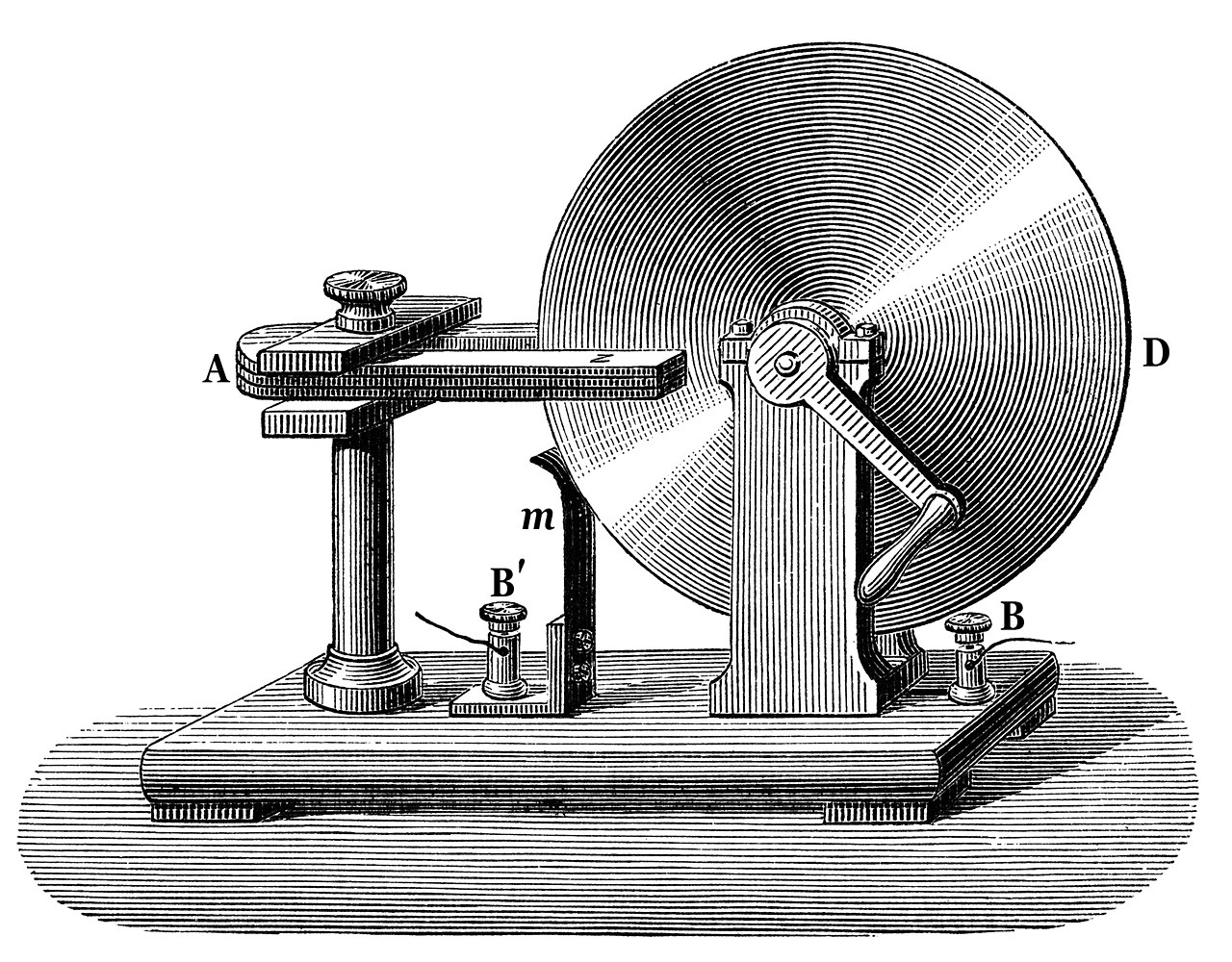
Faraday's first generator
The decades that followed Faraday’s discovery of the electric motor gave him the fame and confidence to dive deep into this new world of electricity and magnetism. It was an exhilarating time of discovery. By 1839, he felt there had been several “valuable communications... essential to the history and progress of science” that had not been adequately published, and their publication dates were not clear. So, in an attempt to provide a “degree of consistency and apparent general accuracy” to this new and important field, he compiled various experiments (by him and others) and began publishing corrections and notes in his Experimental Researches In Electricity—a three volume compendium. It is a fascinating read, filled with wonderful experimental descriptions despite the limitations of language (e.g. the word 'voltage' didn’t exist back then, it was called electric tension), as well as introducing many new words such as electrolytes, electro-dynamic and induction. It is precisely by introducing this concept, induction, that he begins Volume 1, beautifully—albeit relying heavily on the power of hindsight. He describes two electromagnets—each made using exactly two hundred and three feet of copper wire—one connected to a voltaic pile and another to a galvanometer. “When the contact was made,” he writes “there was a sudden and very slight effect at the galvanometer, and there was also a similar slight effect when the contact with the battery was broken”. However, this effect did not happen while the current was steadily running. Much later, on volume 2 (published in 1844), he goes back to the first time he saw the power of induction, using permanent magnets back in 1832. He does this through the letters of others. One from Signore Nobili and Anonili who referenced Faraday’s work in which a spark was generated while moving a permanent magnet through a helix of wire with a slight gap in the connection. Faraday adds notes to the letters of his skeptic colleagues, and describes their lack of enthusiasm for this momentous event. He was not deterred. Further down, he has to defend his motives and often is forced to politely correct the mistakes of Nobili and Anonili when referring to other individuals studying the same effect. Redemption finally comes when Nobili refers to Faraday’s experiment and discovery on the rotating disk (the first generator ever) as “one of the most beautiful of our time.” A high praise, for so skeptic a man. Posterity attributes the discovery of electromagnetic induction to Faraday on October 17th 1831, and the making of the first generator a few days later.
Sources: 1) Faraday, Michael. Experimental Researches in Electricity. Vol. 1. London: R. and J. E. Taylor, 1839. 2) Faraday, Michael. Experimental Researches in Electricity. Vol. 2. London: Richard and John Edward Taylor, 1844
Public Domain
Back to archive
Full disclosure, I may occasionally borrow a sentence from Will Durant's Story of Civilization. I absolutely love that collection!