

Faraday's electric motor
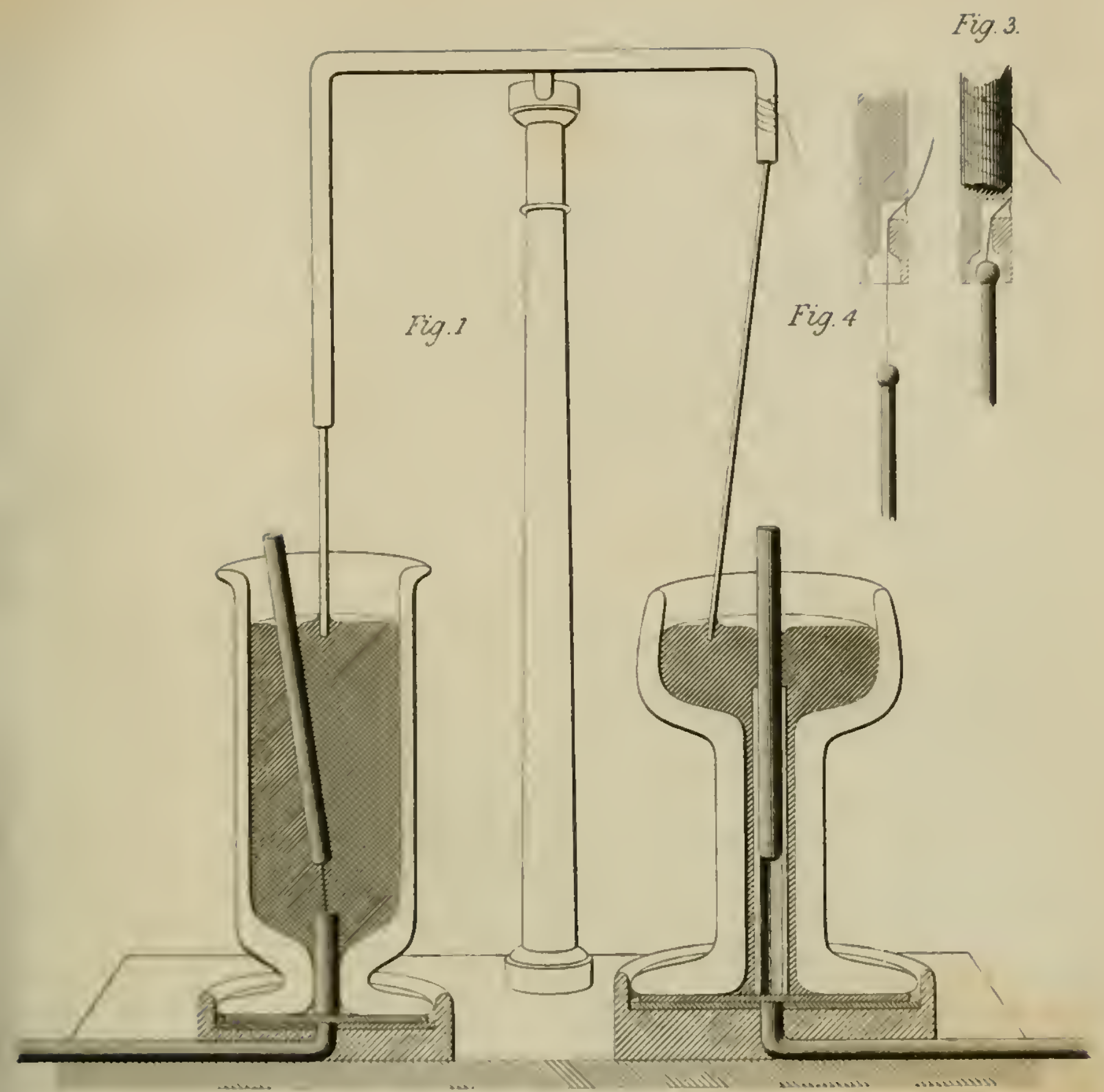
On April 21st 1820, Hans Christian Ørsted was the first to make the connection between electricity and magnetism by deflecting a compass needle away from magnetic north using a wire and a battery. This remarkable discovery caused a sensation around the world and got scientists thinking about the invisible forces and hidden connections between the different natural phenomena. Around this time, Michael Faraday—a self educated book binder who had become Humphry Davy’s assistant—was determined to explore the reasons and the uses of this mysterious force. A year later, he published an article called On some new Electro-Magnetical Motions, and on the Theory of Magnetism, published on September 11, 1821. In this letter, aside from referencing Ørsted’s experiment, Faraday relies heavily on Ampere’s finding of repulsion and attraction in wires carrying current to explain the observed phenomena. However, Faraday struggles to explain why the wire appears to move in a circle. With his characteristic caution, he claims that these forces “are deceptive and may be resolved into the circular motion”, and humbly points out that “the high authority of Dr. Wollaston” claims that simple attraction is sufficient to explain all the phenomena. He gets very close to the real explanation by pointing out the circular pattern of iron filings near a magnet, and speculates that these may be “showing the path” for the needle to follow. What Faraday was missing was the orthogonal nature of the Lorentz force, which causes it to be azimuthal (and therefore circular) in his motor’s configuration. As it often happened in his career, Faraday had the right intuition to bring him closer than anyone to having a complete understanding, but his humble caution prevented him from having a confident eureka moment. Nevertheless, his motor pointed him (and humanity) towards a new era of electricity that would eventually power the world. Next to the steam engine, Michael Faraday’s mercury bowl electric motor was one of the most revolutionary inventions of that century, but he was only getting started…
Source: Faraday, M. On some new Electro-Magnetical Motions, and on the Theory of Magnetism. Quarterly Journal of Science, Literature, and the Ats 12, 414–422 (1821).
Public Domain
Back to archive
Full disclosure, I may occasionally borrow a sentence from Will Durant's Story of Civilization. I absolutely love that collection!