

Alhazen
The brightest name in Muslim Egyptian science is that of Muhammad ibn al-Haitham, known to medieval Europe as Alhazen, born at Basra in 965 CE. We know Alhazen chiefly by his Kitab al-Manazir, or Book of Optics, which he finished in 1021, and in which he exposed many truths about the nature of light. He rejected the theory of Euclid and Ptolemy that vision results from a ray leaving the eye and reaching the object; rather “the form of the perceived object passes into the eye, and is transmitted there by the transparent body”—the lens. He remarked the effect of the atmosphere in increasing the apparent size of sun or moon when near the horizon; showed that through atmospheric refraction the light of the sun reaches us even when the sun is as much as nineteen degrees below the horizon; and on this basis he calculated the height of the atmosphere at ten miles. He observed the half-moon shape of the sun's image, during eclipses, on the wall opposite a small hole made in the window shutters; this is the first known mention of the camera obscura, on which all photography depends. Without him we might never have been heard of Roger Bacon; Bacon quotes him or refers to him at almost every step in that part of the Opus maius which deals with optics; and Part VI rests almost entirely on the findings of the Cairene physicist. As late as Kepler and Leonardo, European studies of light were based upon Alhazen’s work. One of his most memorable lines is “The duty of the man who investigates the writings of scientists—if learning the truth is his goal—is to make himself an enemy of all that he reads...and attack it from every side. He should also suspect of himself, as he performs this critical examination, to avoid falling into either prejudice or careless thinking.” His life marked the turn of the tenth century into the eleventh as the zenith of Islamic culture, and the climax of medieval thought.
Source: Durant, Will, 1885-1981, The Age of Faith: A History of Medieval Civilization, Christian, Islamic, and Judaic, From Constantine to Dante, A.D. 325-1300. Simon and Schuster, 1950.
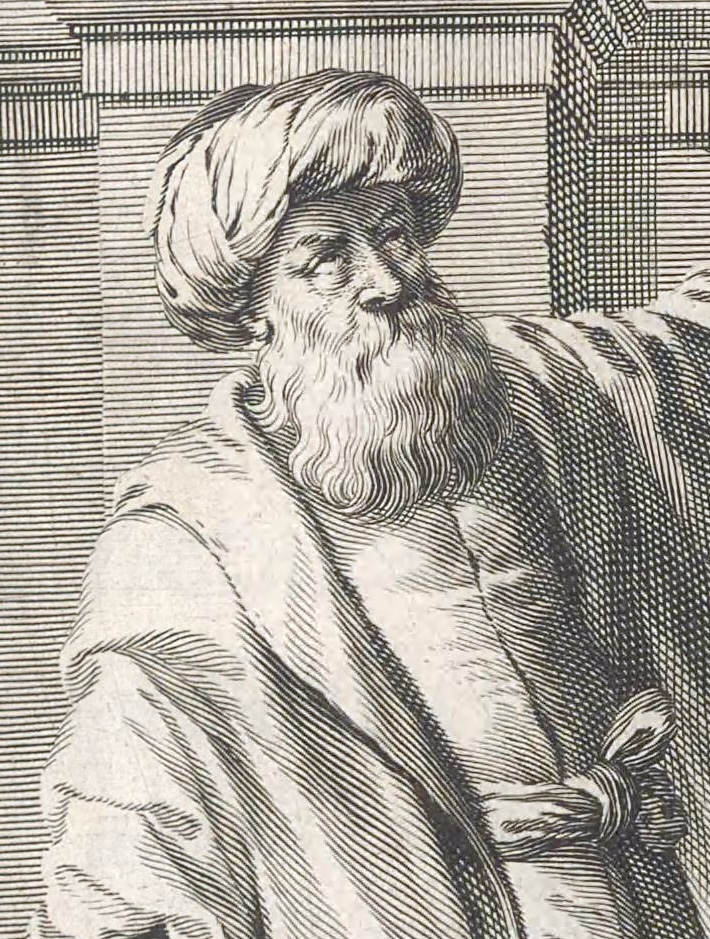
Public Domain
Back to archive
Full disclosure, I may occasionally borrow a sentence from Will Durant's Story of Civilization. I absolutely love that collection!