

Darius and Xerxes
Darius I died in 485 BCE and was succeeded by his son Xerxes, who planned to invade Greece, and did so in 481 BCE with the largest army ever assembled before the 20th century. His navy was composed of twelve hundred and seven ships, and his army had 2,641,000 fighting men, and an equal number of engineers, slaves, merchants, provisioners, and prostitutes. "When Xerxes army drank water" said Herodotus, "whole rivers ran dry". As the war unfolded, improbable victories like that of the Battle of Salamis and the Battle of Plataea eroded Persian momentum despite them reaching Athens. Such was the Greco-Persian war which made Europe possible—but the war didn't end fully with these Athenian victories. Intermittently the struggle continued.
Source: Durant, Will, 1885-1981, Our Oriental Heritage: Volume I Simon and Schuster, 1935.
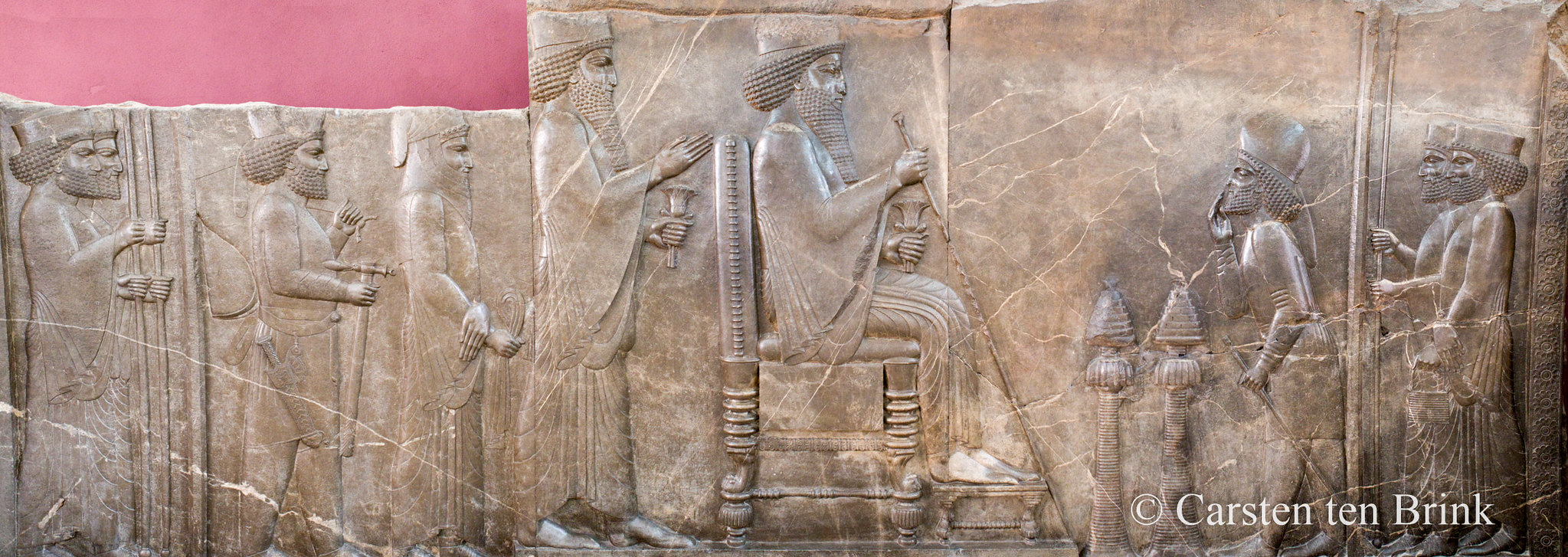
Image by Carsten ten Brink under CC BY-NC-ND 2.0
Back to archive
Full disclosure, I may occasionally borrow a sentence from Will Durant's Story of Civilization. I absolutely love that collection!