

Diogenes
Diogenes—one of the most famous philosophers and interesting characters of ancient Greece—was born around 412 BCE. His teacher Anthestines was the founder of the Cynic school, rejecting all pleasures and possessions and living as simply as one can. “I do not possess, in order not to be possessed”, he claimed. Nonetheless there was a tone of grandiosity in this claim; “I can see your vanity, Antisthenes” Socrates once said “through the holes of your cloak.” At first, Antisthenes refused to take Diogenes as a pupil; Diogenes insisted, bore insult patiently, was received, and made his teacher's doctrine famous throughout Hellas by living it completely. He envied the simple life of animals, and tried to imitate it; he slept on the ground (for some time inside a cask), ate what he could find wherever he found it, and (we are assured) pooped and masturbated in public. Sometimes he carried a candle or a lantern saying that he was looking for a man. His only possession was a drinking cup, but upon seeing a child drink from his hands, he threw it away. He traveled leisurely, and we hear of him living for a time in Syracuse. On one of his journeys he was captured by pirates, who sold him as a slave to Xeniades of Corinth. When his owner asked him what he could do, he answered, “Govern men.” Xeniades made him tutor of his sons and manager of his household, in which capacities Diogenes did so well that his master called him “a good genius,” and took his advice in many things. Something of a poseur, he became as famous as Alexander, and evidently relished his renown. One time, at Corinth, Alexander came upon Diogenes lying in the sun. “I am Alexander the Great King,” said the ruler. “I am Diogenes the dog,” said the philosopher. “Ask of me any favor you choose,” said the King. “Stand a little less between me and the Sun,” answered Diogenes. “If I were not Alexander,” said the young warrior, “I would be Diogenes”. The two men seem to have died on the same day in 323 BCE. Some say Diogenes killed himself by holding his breath. After Diogenes, the Cynics became a religious order without religion; making poverty the norm and contradicting their philosophy by tempering their celibacy with promiscuity—proving that asceticism without a deity is a lost cause. Through Diogenes' disciples, Stilpo and Crates, the Cynic doctrine formed the basis of what later became (via a second Zeno) a less extreme and more virtuous version of Cynicism: Stoicism
Source: Durant, Will, 1885-1981, The Life of Greece: A history of Greek government, industry, manners, morals, religion, philosophy, science, literature and art from the earliest times to the Roman conquest. Simon and Schuster, 1939.
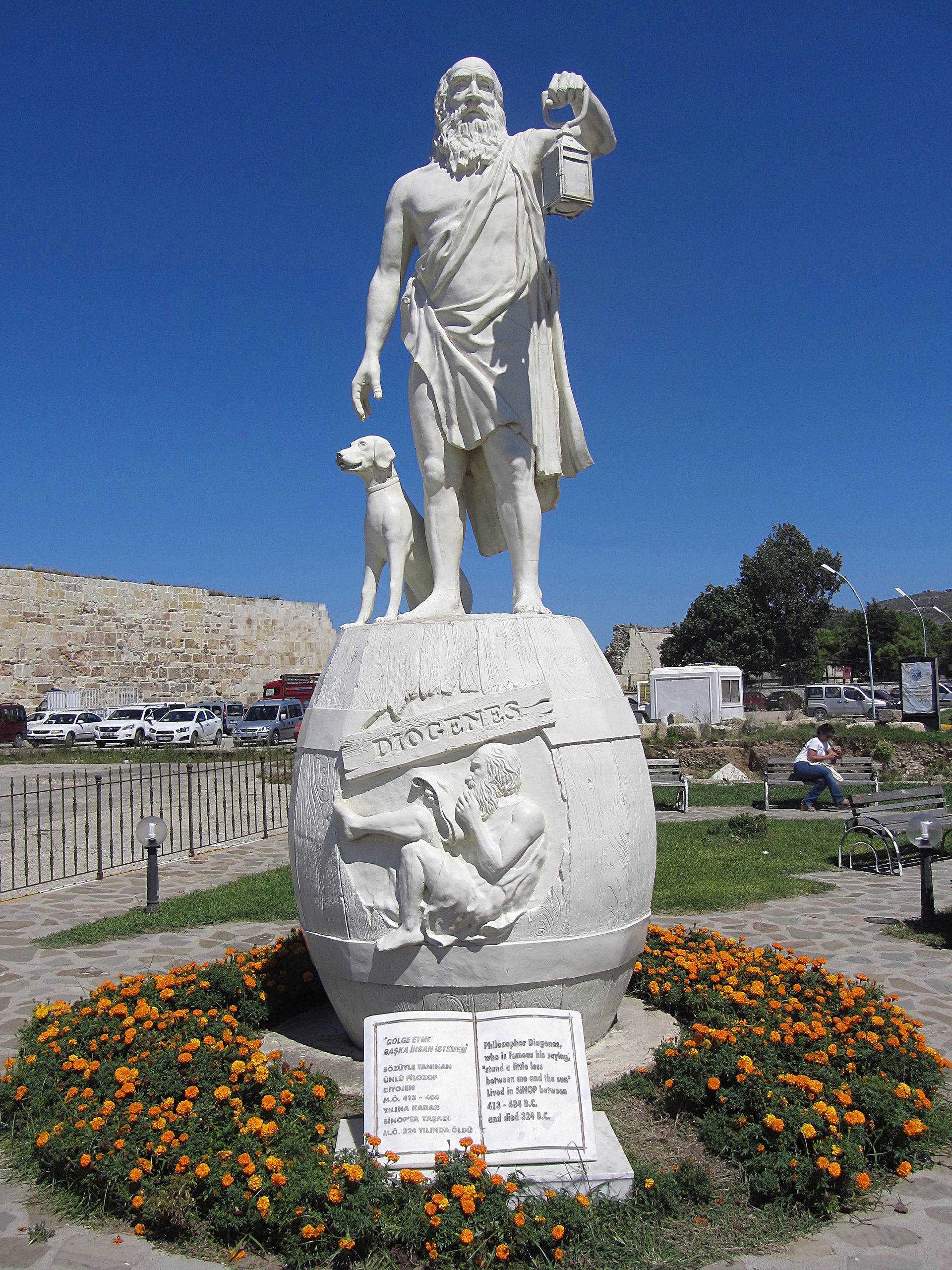
Image by Michael F. Schönitzer under License CC BY-SA 4.0
Back to archive
Full disclosure, I may occasionally borrow a sentence from Will Durant's Story of Civilization. I absolutely love that collection!