

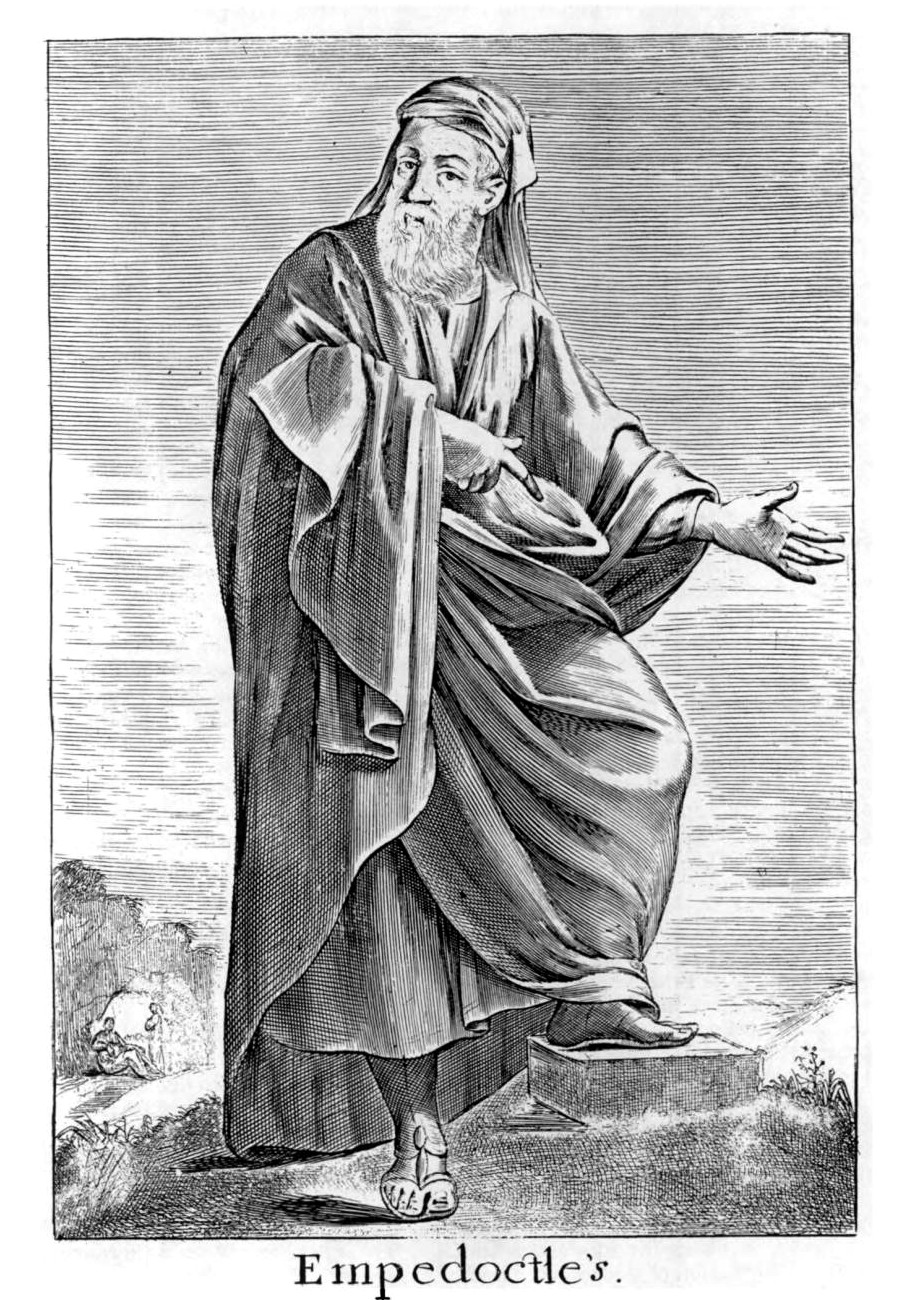
Empedocles
Around 494 BCE, Empedocles was born in Acragas. It is hard to classify him as a philosopher, a polymath, or simply a miracle man—but we do know he was a poet, orator, physician, quite the athlete, and the engineer who freed Selinus from pestilence by draining marshes and changing the course of streams. He recognized that the heart as the center of the vascular system, and described it as the organ by which the pneuma, or vital breath (oxygen?), is carried through the blood vessels to every part of the body. Speaking of breath, he proved the existence of air by pointing out that water would not come out of a pot when the breathing hole was blocked—for it must be replaced by something. A much more practical man than than the idealists, he deprecated Parmenides' wholesale rejection of the senses. In fact, this ability to see past theory got him expelled from the Pythagorean academy as a young lad. He liked the Materialists, and welcomed each sense as an avenue to understanding. But at the same time, he was also much more spiritual than that; thinking himself somewhat of a god and claiming: “From what glory, from what immeasurable bliss, have I now sunk to roam with mortals on this Earth!” Modesty was not his strong suit. Among his scientific contributions we find the theory of evolution, the fact that light has a finite speed, and that night is caused by the earth intercepting the rays of the sun. In his last years he became more distinctly a preacher and prophet—absorbed in the theory of reincarnation—and imploring his fellow men to purge away the guilt that had exiled them from heaven. Hippobotus, says Diogenes Laertius, tells how Empedocles, after bringing back to full life a woman who had been given up for dead, rose from the feast that celebrated her recovery, disappeared, and was never seen again. Legend has it that he leaped into Etna's fiery mouth so that he might die without leaving a trace behind him, and thereby confirm his divinity. Only his golden sandals were found.
Source: Durant, Will, 1885-1981, The Life of Greece: A history of Greek government, industry, manners, morals, religion, philosophy, science, literature and art from the earliest times to the Roman conquest. Simon and Schuster, 1939.
Public Domain
Back to archive
Full disclosure, I may occasionally borrow a sentence from Will Durant's Story of Civilization. I absolutely love that collection!